About 345 minutes
The secret in the hill — Context and Discussion
Young Readers Enchanted Adventures
79,338 recorded words. 14 minutes difference from this book's estimate.
View Gutenberg source #68712
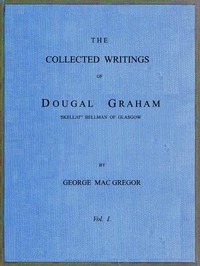
Before opening The Collected Writings of Dougal Graham, "Skellat" Bellman of Glasgow, Vol. 1 of 2 — A Reader’s Guide, the edition data offers a quick orientation: 76,099 words, 5 hr 31 min estimated reading time, and 22 detected text sections.
The text analysis averages about 31.1 words per sentence, while the detected sections provide another way to judge how the source is divided.
Project Gutenberg metadata also associates the work with “Jacobite Rebellion, 1745-1746,” connecting these edition facts with the source record’s subject description.
Explore this collection
These alternatives are selected using recorded categories and estimated reading time.
About 345 minutes
Young Readers Enchanted Adventures
79,338 recorded words. 14 minutes difference from this book's estimate.
View Gutenberg source #68712About 357 minutes
Young Readers Enchanted Adventures
81,930 recorded words. 26 minutes difference from this book's estimate.
View Gutenberg source #68084About 366 minutes
Young Readers Enchanted Adventures
84,161 recorded words. 35 minutes difference from this book's estimate.
View Gutenberg source #64534Search stored excerpts and compare books → Choose by your preferences →
Choices use stored catalog measurements. Estimates vary with reading speed. A shared category is a catalog label, not a claim that two books have the same argument or literary quality.
Search reads excerpt text stored with this catalog and links to its associated Gutenberg record. The connection is stored in the site database; this tool does not recheck that every excerpt is word-for-word identical to that external record. Excerpt search does not cover every chapter and does not verify historical publication dates.
Catalog snapshot checked: 2026-09-25. Coverage: 92 public books, 92 available source excerpts.
Read the complete public-domain text at its original source.
Read on Project GutenbergDougal Graham, known as the 'Skellat' Bellman of Glasgow, produced chapbooks that circulated widely among common readers in 18th-century Scotland. This volume, the first of two, collects his surviving works, beginning with his longest piece: a verse account of the Jacobite Rebellion of 1745–46. The editor, George Mac Gregor, explains that Sir Walter Scott and William Motherwell both planned to preserve Graham's writings but never did; this edition finally combines their intentions. The text is drawn from extremely rare editions, and the footnotes clarify obscure references and trace the development of Graham's material.
The opening excerpt shows Graham writing in a brisk, colloquial Scots verse. He describes the battle at Inverurie with a reporter's eye for movement: 'The first intelligence some got / Was by the rattling of the shot.' His metre is irregular, often forcing rhymes with compressed syntax, as in 'He rallied them near to the mill.' The narrative voice is that of an observer who admits his own limits—'At what I've seen my heart does shrink'—yet presses on with the story. This mixture of personal reaction and factual recital gives the history a distinctive, unpolished energy.
Mac Gregor's preface and footnotes are integral to the reading experience. He notes that this edition is limited to 250 copies, and that the text has been transcribed from images provided by the HathiTrust Digital Library. The footnotes explain historical figures, place names, and Scots words, such as 'billoting' (billeting) and 'stour' (conflict). They also trace Graham's sources and variations between editions. Readers unfamiliar with 18th-century Scottish politics will find these notes essential for following the rapid shifts of allegiance and geography in the verse.
The verse history proceeds chronologically, but Graham often pauses to comment on the action. After describing the 'bloody butch'ry' at Carlisle, he writes, 'Of such like acts I'll say no more, / But follow the subject just before.' This self-interruption is typical: he balances horror with a determination to keep the narrative moving. The battle scenes are detailed with troop movements, place names, and the names of commanders—Lord Lewis Gordon, Lord John Drummond, MacLeod—but Graham also includes the reactions of common soldiers and civilians. The result is a hybrid of chronicle and ballad.
Graham's works were printed as cheap chapbooks, sold by pedlars and at fairs. The editor notes that many of these 'have been floating about the country in unconsidered fragments' and were in danger of destruction. This volume preserves them in a single collection, with variants and illustrations (including a portrait from the 1774 edition of the History of the Rebellion). The physical format of the original chapbooks—small, unbound, often crudely printed—shapes the reading experience: the texts are short, episodic, and meant to be read aloud or passed from hand to hand.
Approach this volume as a window into a lost print culture. Graham's verses reward slow reading: the Scots dialect and irregular metre require attention, but the footnotes and editor's introduction provide the necessary context. The rebellion narrative is only part of the collection; later sections include other chapbook pieces. Let the editor's apparatus guide you, but listen for Graham's own voice—blunt, sometimes grim, always eager to tell what he saw or heard.
The crackle of those firelight lines about the ’45 took me back to my grandfather’s shelf, where I first found his worn copy of The Flying Inn — how The Flying Inn — Edition Insights made me feel that same strange ache for voices carried through time, half-forgotten, yet somehow still warm to the touch.
Build a private reading journal entry for this title.