About 217 minutes
Wee Willie Winkie, and Other Stories. Volume 2 (of 2) — Reading Notes
Young Readers Enchanted Adventures
49,779 recorded words. 48 minutes difference from this book's estimate.
View Gutenberg source #63487
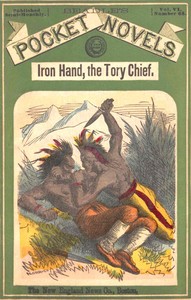
Iron Hand, Chief of the Tory League; or, The Double Face — Story, Setting & Ideas can be approached with a clearer sense of reading commitment from its source measurements: 38,771 words, 2 hr 49 min estimated reading time, and 17 detected text sections.
The text analysis averages about 17.2 words per sentence, while the detected sections provide another way to judge how the source is divided.
Project Gutenberg metadata also associates the work with “Indians of North America -- Fiction,” connecting these edition facts with the source record’s subject description.
Explore this collection
These alternatives are selected using recorded categories and estimated reading time.
About 217 minutes
Young Readers Enchanted Adventures
49,779 recorded words. 48 minutes difference from this book's estimate.
View Gutenberg source #63487About 115 minutes
Young Readers Enchanted Adventures
26,256 recorded words. 54 minutes difference from this book's estimate.
View Gutenberg source #67280About 254 minutes
Young Readers Enchanted Adventures
58,200 recorded words. 85 minutes difference from this book's estimate.
View Gutenberg source #59340Search stored excerpts and compare books → Choose by your preferences →
Choices use stored catalog measurements. Estimates vary with reading speed. A shared category is a catalog label, not a claim that two books have the same argument or literary quality.
Search reads excerpt text stored with this catalog and links to its associated Gutenberg record. The connection is stored in the site database; this tool does not recheck that every excerpt is word-for-word identical to that external record. Excerpt search does not cover every chapter and does not verify historical publication dates.
Catalog snapshot checked: 2026-09-25. Coverage: 92 public books, 92 available source excerpts.
Read the complete public-domain text at its original source.
Read on Project GutenbergFrederick Forest opens Iron Hand, Chief of the Tory League; or, The Double Face with a sweeping historical preamble that frames the American Revolution as a natural outgrowth of colonial manhood and resistance to British oppression. The narrative then narrows to a white cottage near Lake George in 1778, where two men discuss politics over wine. The hero, Edgar Sherwood, is introduced with precise physical description—gray eyes that might be mistaken for black, dark-brown hair curled close to his head—and a backstory of fraternal conflict over inheritance. This blend of broad historical stage-setting and intimate character detail is typical of the dime novel tradition, where personal vendettas mirror national struggles.
Forest’s prose oscillates between formal, almost legalistic exposition and highly emotional outbursts. The opening paragraphs employ phrases like “narrow and oppressive policy” and “principles of civil and religious liberty,” echoing the language of revolutionary pamphlets. Yet when characters speak, the register shifts dramatically. The antagonist’s threat—“Mark ye! I will give you three days to reconsider your rash decision”—uses archaic second-person pronouns and a theatrical cadence that signals villainy. This contrast between the narrator’s measured tone and the characters’ fevered speech creates a sense of heightened stakes, where every conversation is a potential confrontation.
Forest relies heavily on physical cues to convey emotion, often in place of interior monologue. When Imogene faints after the Tory’s visit, she “reeled, and sunk swooning to the floor.” Edgar, upon hearing of her disappearance, “uttered a deep groan” and sat with “his head sunk forward on his knees.” These exaggerated bodily responses—groaning, staring vacantly, sinking—are the dime novel’s shorthand for psychological depth. The narrator also describes Colonel Hall’s “stern look settling on his brow” as he vows vengeance. Such descriptions externalize inner states, making them legible to a reader accustomed to visual storytelling.
Forest uses natural light to underscore emotional turning points. The morning after Edgar’s arrest, “the bright sunbeams struggled through the narrow, grated window” and “brilliantly illuminated the apartment.” Yet for the prisoner, this sunlight only mocks him: “it seemed, as it were, that every thing mocked him.” The contrast between the joyful light and Edgar’s despair reinforces the theme of false appearances—a motif hinted at in the subtitle “The Double Face.” Similarly, the decaying fire in his cell becomes a focus for his troubled gaze. These recurring details of illumination and decay give the setting a symbolic weight beyond mere backdrop.
The excerpts reveal a narrative strategy of withheld information. Edgar’s brother, mentioned only in the opening, is established as a source of past conflict but remains offstage. The villain’s speech—“I alone possess that power”—echoes the brother’s earlier claim of injustice, suggesting a parallel between personal and political betrayal. Forest’s dialogue often carries double meanings: when Colonel Hall says “the affliction is not so much my own… as my friend’s,” the delayed reveal that the friend is Edgar himself creates a moment of dramatic irony. These verbal maneuvers keep the reader alert to hidden motives and shifting allegiances.
Readers should attend to how Forest deploys stock situations—the quarrel, the midnight ride, the secret mission—as scaffolding for his real interest: the clash between public duty and private grievance. The novel’s title promises a chief and a league, but the excerpts focus more on individual confrontations and psychological pressure than on collective action. Pay attention to who speaks and how; the characters’ voices, rather than the plot mechanics, carry the story’s emotional weight.
There’s something about old stories that linger, like the shadowy turn of a page in Forest’s Iron Hand—that quiet ache of choices made in the dark. It reminded me of how Wise Men and a Mule — Reading Companion stays with you, not for its plot, but for the gentle weight of its silences. Both feel like memories you didn’t know you carried.
Create a short personal record of your experience with this book.