About 254 minutes
The Motor Boys on Thunder Mountain; Or, The Treasure Chest of Blue Rock — Key Ideas to Explore
Young Readers Enchanted Adventures
58,200 recorded words. 37 minutes difference from this book's estimate.
View Gutenberg source #59340
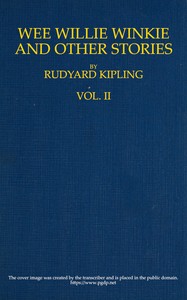
Before opening Wee Willie Winkie, and Other Stories. Volume 2 (of 2) — Reading Notes, the edition data offers a quick orientation: 49,779 words, 3 hr 37 min estimated reading time, and 11 detected text sections.
The text analysis averages about 17.5 words per sentence, while the detected sections provide another way to judge how the source is divided.
Project Gutenberg metadata also associates the work with “Children -- Fiction,” connecting these edition facts with the source record’s subject description.
Explore this collection
These alternatives are selected using recorded categories and estimated reading time.
About 254 minutes
Young Readers Enchanted Adventures
58,200 recorded words. 37 minutes difference from this book's estimate.
View Gutenberg source #59340About 169 minutes
Young Readers Enchanted Adventures
38,771 recorded words. 48 minutes difference from this book's estimate.
View Gutenberg source #65831About 115 minutes
Young Readers Enchanted Adventures
26,256 recorded words. 102 minutes difference from this book's estimate.
View Gutenberg source #67280Search stored excerpts and compare books → Choose by your preferences →
Choices use stored catalog measurements. Estimates vary with reading speed. A shared category is a catalog label, not a claim that two books have the same argument or literary quality.
Search reads excerpt text stored with this catalog and links to its associated Gutenberg record. The connection is stored in the site database; this tool does not recheck that every excerpt is word-for-word identical to that external record. Excerpt search does not cover every chapter and does not verify historical publication dates.
Catalog snapshot checked: 2026-09-25. Coverage: 92 public books, 92 available source excerpts.
Read the complete public-domain text at its original source.
Read on Project GutenbergThe opening of “The Man who would be King” establishes a narrator who has been “fellow to a beggar” and nearly “brother to a Prince,” framing the story as a retrospective account of a lost kingdom. The intermediate-class railway carriage—described as “very awful indeed,” with no cushions and a population of Eurasians, natives, and loafers—becomes a microcosm of colonial India’s social hierarchies. The big, black-browed stranger who enters at Nasirabad immediately challenges the narrator’s assumptions, claiming that if India were filled with men like them, the revenue would be seven hundred millions instead of seventy. This boastful, almost anarchic energy sets the tone for a tale that tests the boundaries of imperial order.
Kipling’s prose in these excerpts is finely attuned to the markers of rank and race. The intermediate class is not merely a travel category but a moral and social space: its passengers are “looked down upon” and, in hot weather, “taken out of the carriages dead.” The stranger’s remark about revenue—a precise, almost bureaucratic figure—underscores how economic value is tied to human audacity. Later, in “Baa Baa, Black Sheep,” the child Punch (called Black Sheep) observes that some schoolmates “were unclean, some of them talked in dialect, many dropped their h’s, and there were two Jews and a negro.” His internal label “hubshi” (a derogatory term for a Black person) echoes the casual prejudice of the adult world. These details do not merely depict setting; they reveal how characters internalize the empire’s hierarchies, using language and observation to place themselves and others.
The stories featuring children—Wee Willie Winkie, Baa Baa, Black Sheep, and His Majesty the King—present young protagonists who are scrutinized, punished, or romanticized by adults. In the excerpt from “Baa Baa, Black Sheep,” Punch’s aunt, Aunty Rosa, calls him a “little devil” and a “little liar,” while his brother Harry acts as “the censor of Black Sheep’s morals.” The child’s internal world is rendered with sharp irony: he reads a forbidden book called Cometh up as a Flower with “deep and uncomprehending interest,” and when Uncle Harry dies, Punch’s excitement at the song of Navarino is met with a scream to hush. Kipling gives the child a precise, unsentimental voice—thinking “I don’t think I’ve done anything bad that she knows of”—that contrasts with the adults’ melodramatic judgments. The school scene, where Punch is indignant that his peers “live in shops,” shows how even a child replicates the empire’s snobberies.
Both “The Man who would be King” and “Baa Baa, Black Sheep” employ framing devices that complicate the reader’s trust. The former opens with a narrator who admits he has “still to be brother to a Prince” and fears his king is dead, creating a retrospective, elegiac tone. The latter is introduced by a third-person narrator who refers to the protagonist as “Black Sheep” throughout, a label that the story itself questions. When Punch thinks, “I wonder what will happen to me now,” after Uncle Harry’s death, the narrative withholds any easy sympathy, letting the child’s pragmatic calculation stand. These frames do not resolve into moral clarity; instead, they leave the reader to weigh the gap between how characters see themselves and how they are seen. Kipling’s use of precise, almost legalistic language—such as “the bonds of the Universe were crumbling”—further distances the emotional content, inviting a cooler assessment of the events.
Readers approaching this volume will find that Kipling’s short fiction rewards attention to his narrative architecture—the way a railway carriage, a nursery, or a schoolroom becomes a stage for larger conflicts. The stories are not simply adventures or moral tales; they are studies in perspective, where the same event can be read as triumph or tragedy depending on who tells it. Pay particular attention to the moments when a character’s private thought contradicts the official story, as these are the hinges on which Kipling’s irony turns.
I've often lingered over those Kipling stories, where grand imperial schemes crumble against human frailty. Years later, I find the same uneasy pulse in The war of the Carolinas — Text and Context, though its battles are quieter. Both whisper of how our proud intentions get tangled with what we cannot control. A familiar, melancholy warmth settles in, like old friends sharing a weary secret.
Build a private reading journal entry for this title.