About 453 minutes
The girl from Hollywood — Themes and Context
Time Travel Speculative Futures
104,163 recorded words. 7 minutes difference from this book's estimate.
View Gutenberg source #62409
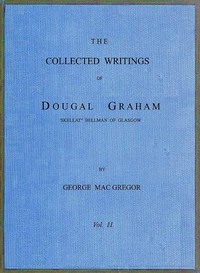
For The Collected Writings of Dougal Graham, "Skellat" Bellman of Glasgow, Vol. 2 of 2 — Reading Companion, the stored edition analysis reports 105,755 words, 7 hr 40 min estimated reading time, and 64 detected text sections.
The text analysis averages about 31.0 words per sentence, while the detected sections provide another way to judge how the source is divided.
Project Gutenberg metadata also associates the work with “Jacobite Rebellion, 1745-1746,” connecting these edition facts with the source record’s subject description.
Explore this collection
These alternatives are selected using recorded categories and estimated reading time.
About 453 minutes
Time Travel Speculative Futures
104,163 recorded words. 7 minutes difference from this book's estimate.
View Gutenberg source #62409About 489 minutes
Time Travel Speculative Futures
112,295 recorded words. 29 minutes difference from this book's estimate.
View Gutenberg source #68153About 420 minutes
Time Travel Speculative Futures
96,574 recorded words. 40 minutes difference from this book's estimate.
View Gutenberg source #63479Search stored excerpts and compare books → Choose by your preferences →
Choices use stored catalog measurements. Estimates vary with reading speed. A shared category is a catalog label, not a claim that two books have the same argument or literary quality.
Search reads excerpt text stored with this catalog and links to its associated Gutenberg record. The connection is stored in the site database; this tool does not recheck that every excerpt is word-for-word identical to that external record. Excerpt search does not cover every chapter and does not verify historical publication dates.
Catalog snapshot checked: 2026-09-25. Coverage: 92 public books, 92 available source excerpts.
Read the complete public-domain text at its original source.
Read on Project GutenbergDougal Graham, known as the 'Skellat' Bellman of Glasgow, produced a body of work that straddles oral tradition and print culture. This second volume of his collected writings brings together chapbooks that were sold on street corners and at fairs, offering a direct line to the humor, prejudices, and daily concerns of 18th-century Scottish commoners. The texts are not polished literary productions but vigorous, often coarse, dialogues and narratives built around stock characters—the naive servant, the cunning peddler, the henpecked husband.
What strikes a modern reader is the sheer physicality of the comedy. In 'The Comical Sayings of Pady from Cork,' a servant's mishandling of a fish, a chamber pot, and a bottle of wine leads to beatings and broken objects, all recounted with deadpan logic. The humor relies on a world where cause and effect are wildly mismatched, and where the body—its needs, its failures, its pains—is never far from the page.
The chapbooks in this collection are overwhelmingly written in dialogue form, a choice that reflects both oral performance traditions and a keen eye for social hierarchy. In 'Jockey and Maggy’s Courtship,' the back-and-forth between lovers, parents, and the minister exposes the economic realities behind marriage—dowries, land, and the threat of bastard children. The characters speak in distinct vernaculars: Jockey’s broad Scots, Maggy’s pragmatic retorts, the minister’s formal tone. Graham uses these voices not for documentary realism but for comic contrast.
Similarly, 'The Comical Sayings of Pady from Cork' pits an Irish servant, Teag, against his Scottish master. Teag’s literal-mindedness—placing a trencher under the chamber pot as ordered—turns the master’s commands into absurdity. The dialogue format allows Graham to stage a battle of wits where the servant’s 'too much wit' undermines authority. Yet the humor is not gentle; beatings are frequent, and the laughter is often at the expense of the underdog. The social order is mocked but ultimately reaffirmed.
Graham’s humor is relentlessly physical. Characters are kicked, cuffed, beaten with sticks, and drenched with broken chamber pots. In 'Pady from Cork,' Teag describes how a nail from his brogue pricks his foot, causing him to break a bottle while trying to hammer it down. The sequence is a cascade of mishaps: the nail, the broken bottle, the lost wine, and finally a beating from the master. The body is both the source of trouble and the object of punishment.
This physicality extends to bodily functions and deformities. The title 'Mussel Mou’d Harry' suggests a character with a misshapen mouth, and 'Leper the Taylor' plays on disease and disability. Graham does not flinch from the grotesque; a 'pish-pot' is named directly, and a character’s head is broken by a thrown vessel. The comedy is coarse, but it also reflects a culture where life was precarious, and the body’s vulnerabilities were a constant reality. The laughter is a defense against pain.
Many of the pieces in this volume are divided into multiple parts, a feature of chapbook publishing that allowed sellers to stretch a popular story across several cheap pamphlets. 'Jockey and Maggy’s Courtship' runs to five parts, tracking the couple from courtship through marriage, childbirth, and the death of Jockey’s mother. 'The Comical Transactions of Lothian Tom' has six parts, each ending on a minor cliffhanger or a new episode.
This serial structure shapes the reading experience. Each part is self-contained enough to be sold separately, yet cumulative in effect. Graham often repeats a formula—a character’s foolishness leads to a beating, then a new scheme. The repetition is part of the pleasure; the reader knows what to expect but enjoys the variations. The glossary at the end of the volume, explaining Scots words like 'brogue' and 'cog,' hints at the gap between Graham’s 18th-century audience and later readers. The editor, George MacGregor, has preserved these texts as historical artifacts, but the serial energy still feels alive.
Readers approaching this volume should set aside expectations of plot or character development. These chapbooks are best enjoyed as performances—read aloud, with voices for each character. The humor is repetitive, scatological, and often cruel, but it offers a rare window into the vernacular culture of pre-industrial Scotland. Pay attention to the rhythms of the dialogue and the way Graham uses dialect for comic effect. The glossary will help, but the real pleasure is in the sheer, unvarnished strangeness of these voices.
That rainy afternoon, Dougal Graham’s sharp-tongued conmen made me laugh, yet their bedraggled schemes left a quiet ache—every trick built from need, not malice. Later, thumbing the shelf, that same unsettled feeling pulled me toward Redlaw, the half-breed; or, The tangled trail. A tale of the settlements — Edition Insights, and I found the frontier’s loneliness mirroring those old Glasgow streets.
Create a short personal record of your experience with this book.