About 204 minutes
The Rejuvenation of Miss Semaphore: A Farcical Novel — Background and Themes
Time Travel Speculative Futures
46,717 recorded words. 17 minutes difference from this book's estimate.
View Gutenberg source #65871
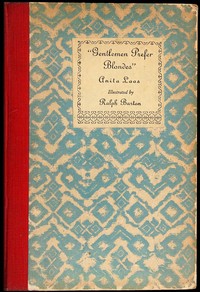
The source record for "Gentlemen prefer blondes" — Reading Companion measures this digital text at 42,876 words, 3 hr 7 min estimated reading time, and 8 detected text sections.
The text analysis averages about 24.6 words per sentence, while the detected sections provide another way to judge how the source is divided.
Project Gutenberg metadata also associates the work with “Humorous stories,” connecting these edition facts with the source record’s subject description.
Explore this collection
These alternatives are selected using recorded categories and estimated reading time.
About 204 minutes
Time Travel Speculative Futures
46,717 recorded words. 17 minutes difference from this book's estimate.
View Gutenberg source #65871About 167 minutes
Time Travel Speculative Futures
38,374 recorded words. 20 minutes difference from this book's estimate.
View Gutenberg source #65587About 164 minutes
Time Travel Speculative Futures
37,711 recorded words. 23 minutes difference from this book's estimate.
View Gutenberg source #58793Search stored excerpts and compare books → Choose by your preferences →
Choices use stored catalog measurements. Estimates vary with reading speed. A shared category is a catalog label, not a claim that two books have the same argument or literary quality.
Search reads excerpt text stored with this catalog and links to its associated Gutenberg record. The connection is stored in the site database; this tool does not recheck that every excerpt is word-for-word identical to that external record. Excerpt search does not cover every chapter and does not verify historical publication dates.
Catalog snapshot checked: 2026-09-25. Coverage: 92 public books, 92 available source excerpts.
Read the complete public-domain text at its original source.
Read on Project GutenbergAnita Loos's Gentlemen Prefer Blondes opens with a diary entry dated March 16th, immediately establishing the first-person voice of Lorelei Lee, a young woman who declares that thinking is her favorite recreation. The novel’s structure is built around dated entries, moving from New York to London, Paris, and Vienna, with each chapter titled after a city or concept. This episodic travelogue is punctuated by recurring images: diamonds, both real and imitation, and the constant exchange of gifts and money. The narrative’s rhythm—short paragraphs beginning with “So” or “I mean”—creates a breathless, conversational tone that undercuts the glamorous settings.
The novel is presented as a diary, a choice that shapes both its voice and its gaps. Lorelei writes only when events seem noteworthy, often skipping weeks or months with a dismissive “nothing practically happens.” The first entry explains the diary’s origin: a senator gives her a blank book, suggesting she write down her thoughts. This frame allows Loos to control what readers see—Lorelei’s perspective is unfiltered, but deliberately incomplete. The diary form also creates a tension between private reflection and public performance, as Lorelei often addresses an implied audience, justifying her actions or boasting about her cleverness.
Throughout the excerpts, diamonds serve as a central symbol, but their value is consistently ambiguous. Lorelei receives a diamond tiara from Sir Francis Beekman, only to discover it is paste. Later, she and her friend Dorothy help two Frenchmen, Louie and Robber, pass off an imitation tiara to Lady Francis Beekman, charging her a fortune. Lorelei’s comment that “it was nothing but paste after all” reveals a world where appearances and reality are interchangeable. The image recurs when Dorothy suggests that Lady Beekman “could nick off a piece of ice and give it to her, only it would melt.” These moments highlight the novel’s critique of social status built on illusion.
The narrative moves from the Ritz in New York to London, Paris, and Vienna, each location offering new opportunities for Lorelei to navigate social hierarchies. In Paris, she and Dorothy are “two American girls all alone” who cannot speak French, yet they manipulate wealthy men with ease. The movement is not just geographical but social: Lorelei shifts from dining with a senator to charming European aristocrats and businessmen. The chapter titled “The Central of Europe” places Vienna as a destination for Mr. Eisman’s button factory, but Lorelei’s interest remains fixed on shopping and entertainment. This restless travel underscores the novel’s satire of the leisure class, where place matters less than the transactions that occur there.
Lorelei’s narrative voice is marked by repeated phrases: “I mean,” “practically,” “quite,” and “really.” These verbal tics create a rhythm that mimics casual speech while subtly undermining her claims to intelligence. For instance, she says, “I seem to be thinking practically all of the time,” but her thoughts rarely stray beyond social maneuvering. The repetition of “So” at the start of sentences gives the prose a childlike, additive quality, as if one event simply follows another without reflection. This style, combined with malapropisms like “encyclopediacs,” signals Loos’s satire of a character who believes herself sophisticated while revealing her limitations.
Readers attentive to structure will notice how Loos uses the diary’s gaps and the repetition of key images to build a coherent satire without overt commentary. The movement between cities is not just travel but a series of stages for performance. Pay attention to what Lorelei chooses to record—and what she omits—as these choices reveal the novel’s deeper critique of materialism and social ambition.
I’ve always loved how Lorelei’s diary sparkles with paste diamonds, never quite fooling anyone, least of all herself. There’s a similar, quieter warmth in The Three Lovers — Reading Companion, where affection itself becomes the cleverest currency. Both books remind me that play-acting, when done with honest eyes, is simply another way of telling the truth. Old friends, those.
Answer a few questions and save a private reflection on this device.