About 164 minutes
The Daughter of Virginia Dare — A Reader’s Guide
Time Travel Speculative Futures
37,711 recorded words. 5 minutes difference from this book's estimate.
View Gutenberg source #58793
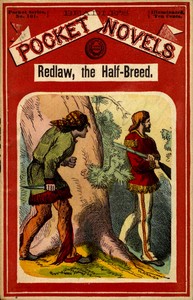
The catalog record for Redlaw, the half-breed; or, The tangled trail. A tale of the settlements — Edition Insights provides practical reading context through 36,535 words, 2 hr 39 min estimated reading time, and 4 detected text sections.
The text analysis averages about 17.3 words per sentence, while the detected sections provide another way to judge how the source is divided.
Project Gutenberg metadata also associates the work with “Indians of North America -- Fiction,” connecting these edition facts with the source record’s subject description.
Explore this collection
These alternatives are selected using recorded categories and estimated reading time.
About 164 minutes
Time Travel Speculative Futures
37,711 recorded words. 5 minutes difference from this book's estimate.
View Gutenberg source #58793About 167 minutes
Time Travel Speculative Futures
38,374 recorded words. 8 minutes difference from this book's estimate.
View Gutenberg source #65587About 187 minutes
Time Travel Speculative Futures
42,876 recorded words. 28 minutes difference from this book's estimate.
View Gutenberg source #66829Search stored excerpts and compare books → Choose by your preferences →
Choices use stored catalog measurements. Estimates vary with reading speed. A shared category is a catalog label, not a claim that two books have the same argument or literary quality.
Search reads excerpt text stored with this catalog and links to its associated Gutenberg record. The connection is stored in the site database; this tool does not recheck that every excerpt is word-for-word identical to that external record. Excerpt search does not cover every chapter and does not verify historical publication dates.
Catalog snapshot checked: 2026-09-25. Coverage: 92 public books, 92 available source excerpts.
Read the complete public-domain text at its original source.
Read on Project GutenbergThe novel opens not with its title character but with a vigilante meeting in a settlement tavern, where Captain Neil calls the group to order. The room fills with distinctive voices: Hannibal Hooker’s “shrill, quavering” pip, the landlord Jim Henderson’s “deep, rumbling” bass from a small frame, and a rotund protester who objects to liquor before planning. This cacophony of speech—each man marked by a vocal tic—establishes a world where identity is performed through talk. The half-breed Redlaw enters later, not as a hero but as a schemer who bribes Sprowl to burn Clay Poynter’s house, revealing a network of paid perjury and hidden grudges.
Badger gives nearly every character a verbal signature. Captain Neil’s speech carries a “slightest possible tinge of the ‘brogue’”; Henderson’s voice is comically outsized for his body; Hannibal Hooker squeaks and quavers. Even minor figures like Sprowl and Polk trade dialogue in clipped, knowing phrases—“Cash down, you know,” “I never split on a friend.” This technique does more than color the page: it turns conversations into power struggles. The opening meeting is a contest of interruptions, protests, and shouted orders. Later, Redlaw’s “villainous mongrel” epithet is matched by his oily persuasiveness (“insinuatingly,” “sharply”). The reader must track who speaks how, because in this settlement, a voice can be a weapon or a disguise.
The plot, as far as the excerpts show, runs on false witness. Poynter is accused of murder and counterfeiting by men who admit they were paid to lie. Sprowl boasts of swearing against Poynter for a hundred dollars, and Redlaw orchestrates arson to tighten the noose. A backstory emerges: a man named Meagreson, who may be the “old man” funding the frame-up, once engineered a lynching in Kentucky. The novel’s title—The Tangled Trail—thus refers not to a physical chase but to a knot of perjured testimony, bribes, and buried crimes. Badger presents law and order as a stage managed by the highest bidder, where a “double sawbuck” buys a half-hour’s treachery.
The action is confined to a few interior spaces: the tavern room, a bush hideout, a house to be burned. Badger uses these settings as theatrical sets for confrontation. The meeting room is described with a deal table, stools, and a door that frames Henderson’s entrance “like a mouse with a lion’s voice.” The bush where Poynter hides is just thick enough for eavesdropping. This compression heightens the sense of a closed community where everyone’s business is known—or can be bought. The Kansas settlements are not a frontier of open spaces but a claustrophobic web of debts, grudges, and whispered deals. Redlaw’s power lies in knowing who owes whom, and in exploiting the gap between public reputation and private crime.
Readers should attend to who speaks and who pays. Badger’s dialogue carries the plot; descriptive passages are sparse. The excerpts do not reveal whether Redlaw is captured or Poynter cleared, but they establish a moral landscape where guilt is a commodity. The novel rewards attention to verbal cues—a brogue, a quaver, a dry chuckle—as signals of allegiance. Treat every conversation as a transaction, and every character’s first line as a clue to their role in the tangled trail.
Reading about Redlaw’s tangled loyalties, I kept thinking of my grandfather’s quiet stories about the border towns—how a man’s past could follow him like smoke. That same ache of identity surfaced in Priscilla of the Good Intent: A Romance of the Grey Fells — Edition Insights, where a woman’s reputation outran her. Both books felt less like adventures, more like portraits of people trying to outwalk their own shadows.
Build a private reading journal entry for this title.