About 34 minutes
Tigre and Isola — Story, Setting & Ideas
Time Travel Speculative Futures
7,730 recorded words. 1 minutes difference from this book's estimate.
View Gutenberg source #64835

The source record for In the Garden of the Gods — A Closer Reading measures this digital text at 7,503 words, 33 min estimated reading time, and 1 detected text section.
The text analysis averages about 16.0 words per sentence, while the detected sections provide another way to judge how the source is divided.
Project Gutenberg metadata also associates the work with “Short stories,” connecting these edition facts with the source record’s subject description.
Explore this collection
These alternatives are selected using recorded categories and estimated reading time.
About 34 minutes
Time Travel Speculative Futures
7,730 recorded words. 1 minutes difference from this book's estimate.
View Gutenberg source #64835About 53 minutes
Time Travel Speculative Futures
12,151 recorded words. 20 minutes difference from this book's estimate.
View Gutenberg source #67732About 54 minutes
Time Travel Speculative Futures
12,212 recorded words. 21 minutes difference from this book's estimate.
View Gutenberg source #67747Search stored excerpts and compare books → Choose by your preferences →
Choices use stored catalog measurements. Estimates vary with reading speed. A shared category is a catalog label, not a claim that two books have the same argument or literary quality.
Search reads excerpt text stored with this catalog and links to its associated Gutenberg record. The connection is stored in the site database; this tool does not recheck that every excerpt is word-for-word identical to that external record. Excerpt search does not cover every chapter and does not verify historical publication dates.
Catalog snapshot checked: 2026-09-25. Coverage: 92 public books, 92 available source excerpts.
Read the complete public-domain text at its original source.
Read on Project GutenbergThe story opens with the narrator, Tavis Q. Damron, lying among kinni-kinic in the Garden of the Gods, his mood thunderous for private reasons. A revolver shot and running feet introduce a chase: a young woman, Katherine Gray, fleeing a hulking man in corduroys. Damron intervenes, but his triumph is undercut by Katherine's deliberate appraisal of his sixty-six inches. The catalog subjects—mate selection, children of the rich, businessmen—are all present, but the narrative voice is the real draw: sardonic, self-deprecating, and alert to the absurdity of its own posturing.
Damron’s narration is the story’s engine. He admits his mood is thunderous, then uses the shifting sun as a text on the futility of life. When Katherine flees to him, he feels a glow of triumph—but she appraises his height, and he huffily compares himself to Napoleon. The voice is consistently ironic: he calls his rescue a contribution to the conversation, and later describes himself as nervous as a youngster awaiting a caning. This self-awareness prevents the story from becoming a simple hero-rescues-damsel plot. The catalog subject of mate selection is filtered through a narrator who knows he is not a conventional hero.
The middle section shifts from chase to conspiracy. Simon Gray, Katherine’s father, and Damron bribe the corduroy-clad man (John) with five hundred twenty-five dollars and a flask of Scotch to abandon his post. The scene is comic: Gray is cool and game, while Damron despairs of hooking their shy fish. The catalog subject of businessmen is literalized—Gray is a Copper King—but the story treats business tactics as farce. The bribery succeeds, and the conspirators leg it down the hill, leaving Damron to face the returning villain. The setting, the Garden of the Gods, becomes a stage for scheming rather than sublime contemplation.
After the bribery, Damron watches Katherine and Halloway (the villain) return, engrossed in each other. He notes their radiance and his own jaundiced eyes; they are in a world primeval, and he is excluded. The story’s structure hinges on Damron’s position as observer rather than participant. He resents their Eden, and when Halloway asks where Gray is, Damron points to the disappearing specks with malicious triumph. The love triangle is less about romance than about Damron’s sulky exclusion. The catalog subject of mate selection here becomes a study in jealousy, with the narrator as the one left out.
The excerpts break off before the story’s resolution, but the pattern is clear: Damron’s voice will continue to undercut his own schemes. Readers should attend to the gap between what Damron says and what he reveals about himself. The catalog subjects are useful starting points, but the story’s real interest lies in its tone—a blend of adventure, farce, and self-mockery that resists easy categorization.
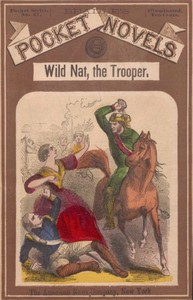
The rain kept up all afternoon, and I kept returning to that sardonic narrator dodging love and gunfire in the Garden of the Gods. His weary humor stayed with me, so I wandered from the shelf to something older, rougher—Wild Nat, the Trooper; or, The Cedar Swamp Brigade — Themes and Context. Different era, same stubborn human mess, and the storm outside made both feel oddly companionable.
Answer a few questions and save a private reflection on this device.