About 159 minutes
Cato, the creeper; or, The demon of Dead-Man's Forest — Context and Discussion
Adventure Picaresque Fiction
36,400 recorded words. 0 minutes difference from this book's estimate.
View Gutenberg source #68343
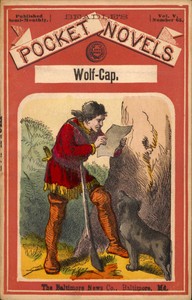
Before opening Wolf-Cap; or, The Night-Hawks of the Fire-Lands: A Tale of the Bloody Fort — Reading Companion, the edition data offers a quick orientation: 36,503 words, 2 hr 39 min estimated reading time, and 5 detected text sections.
The text analysis averages about 14.9 words per sentence, while the detected sections provide another way to judge how the source is divided.
Project Gutenberg metadata also associates the work with “Indians of North America -- Fiction,” connecting these edition facts with the source record’s subject description.
Explore this collection
These alternatives are selected using recorded categories and estimated reading time.
About 159 minutes
Adventure Picaresque Fiction
36,400 recorded words. 0 minutes difference from this book's estimate.
View Gutenberg source #68343About 158 minutes
Adventure Picaresque Fiction
36,247 recorded words. 1 minutes difference from this book's estimate.
View Gutenberg source #66190About 160 minutes
Adventure Picaresque Fiction
36,643 recorded words. 1 minutes difference from this book's estimate.
View Gutenberg source #66249Search stored excerpts and compare books → Choose by your preferences →
Choices use stored catalog measurements. Estimates vary with reading speed. A shared category is a catalog label, not a claim that two books have the same argument or literary quality.
Search reads excerpt text stored with this catalog and links to its associated Gutenberg record. The connection is stored in the site database; this tool does not recheck that every excerpt is word-for-word identical to that external record. Excerpt search does not cover every chapter and does not verify historical publication dates.
Catalog snapshot checked: 2026-09-25. Coverage: 92 public books, 92 available source excerpts.
Read the complete public-domain text at its original source.
Read on Project GutenbergThe novel opens with a trapper alone in a log cabin, his only companion a mastiff named Yellow Dick. The scene is set at nine o'clock on a moonlit night, with a river flowing northward. The trapper's age is ambiguous—'three and forty' but possibly fifty—and his face shows the marks of a hard frontier life. The arrival of Johnny Appleseed, a historical figure, is signaled by the dog's reaction. This beginning establishes a quiet, domestic frontier setting that will soon be disrupted.
The opening chapter introduces a solitary trapper in a rough-hewn cabin, surrounded by traps and furs. The description is precise: 'a small apartment, walled with rough logs, and blackened by smoke.' The fire burns, the dog bristles, and the man peers through a crevice. This is a world of immediate sensory details—sound, sight, and touch. The trapper's speech, with phrases like 'I would hev sworn,' marks him as a frontiersman. The arrival of Johnny Appleseed, a known figure from folklore, blends historical fact with dime-novel fiction. Readers should note how the author uses specific, concrete details to build atmosphere before the plot accelerates.
Later excerpts shift to a tense standoff at a fort. The outlaw Funk, called Night-Hawk, has captured a settler's daughter, Huldah Armstrong. The Wyandot chief Splitlog accuses Funk of betrayal: 'He no man at all who’ll let blue eyes draw him from duty.' A mutiny brews among the British soldiers, with Corporal Quitman challenging Colonel O'Neill. The dialogue is rapid and confrontational, with characters speaking in short, declarative sentences. The scene reveals multiple factions—British, Wyandot, and outlaw—each with competing loyalties. Readers should watch how the author juggles these groups and uses the threat of violence to heighten tension.
Funk's speech to the crowd is a key moment: 'I have fought for the flag of St. George and for the wampum of the Wyandots.' He appeals to both the soldiers and the Indians, claiming that love for a woman made him forget duty. The response is mixed—cheers from some, anger from Splitlog. Funk's threat to shoot the chief if he advances shows his willingness to escalate. The author uses physical action—'springing upon a fallen tree,' 'cocking one of his pistols'—to dramatize the confrontation. This section demonstrates how the dime novel relies on rapid shifts between dialogue and action to maintain momentum.
The excerpts reveal a consistent narrative voice: omniscient but focused on external action. The author rarely enters characters' thoughts, instead showing their emotions through gestures and speech. The structure alternates between quiet scenes (the cabin) and crowded, confrontational ones (the fort). The use of chapter titles like 'Doubly Warned' and 'The Last Night-Hawk' hints at a serialized format. Readers should note how the author builds suspense through short chapters and cliffhangers. The historical setting—War of 1812, frontier Ohio—provides a backdrop for personal conflicts, but the novel prioritizes adventure over historical accuracy.
First-time readers should pay attention to how the author balances multiple plot threads: the trapper's story, the fort's siege, and the outlaw's romance. The excerpts suggest a fast-paced narrative with clear heroes and villains. The use of historical figures like Johnny Appleseed adds a layer of authenticity, while the dime-novel conventions—mutiny, capture, defiance—drive the action. Approach this as a period adventure, not a historical document.
There’s a loneliness in those fire-lands, in how Harbaugh’s outlaws hold their ground against everything, that reminds me of the quiet ache in A Woman of Yesterday — Themes and Context. Both feel like watching someone stand at a window at dusk, not quite ready to turn away. I remember that feeling long after the last page. Strange, how some stories linger that way.
Answer a few questions and save a private reflection on this device.









