About 159 minutes
Wolf-Cap; or, The Night-Hawks of the Fire-Lands: A Tale of the Bloody Fort — Reading Companion
Adventure Picaresque Fiction
36,503 recorded words. 0 minutes difference from this book's estimate.
View Gutenberg source #66231
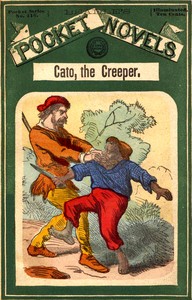
This digital edition of Cato, the creeper; or, The demon of Dead-Man's Forest — Context and Discussion is described by source-level measurements including 36,400 words, 2 hr 39 min estimated reading time, and 17 detected text sections.
The text analysis averages about 14.8 words per sentence, while the detected sections provide another way to judge how the source is divided.
Project Gutenberg metadata also associates the work with “Detective and mystery stories,” connecting these edition facts with the source record’s subject description.
Explore this collection
These alternatives are selected using recorded categories and estimated reading time.
About 159 minutes
Adventure Picaresque Fiction
36,503 recorded words. 0 minutes difference from this book's estimate.
View Gutenberg source #66231About 158 minutes
Adventure Picaresque Fiction
36,247 recorded words. 1 minutes difference from this book's estimate.
View Gutenberg source #66190About 160 minutes
Adventure Picaresque Fiction
36,643 recorded words. 1 minutes difference from this book's estimate.
View Gutenberg source #66249Search stored excerpts and compare books → Choose by your preferences →
Choices use stored catalog measurements. Estimates vary with reading speed. A shared category is a catalog label, not a claim that two books have the same argument or literary quality.
Search reads excerpt text stored with this catalog and links to its associated Gutenberg record. The connection is stored in the site database; this tool does not recheck that every excerpt is word-for-word identical to that external record. Excerpt search does not cover every chapter and does not verify historical publication dates.
Catalog snapshot checked: 2026-09-25. Coverage: 92 public books, 92 available source excerpts.
Read the complete public-domain text at its original source.
Read on Project GutenbergFrederick Dewey opens Cato, the Creeper with a landscape that functions almost as a character: Dead-Man's Forest is described as a "vast, sleepy army of trees" overlooking "acres of treacherous swamp, silent glade, and tiny hillock." The prose lingers on sensory details—the howl of the wolf, the scream of the catamount, the hiss of the venomous snake—before introducing the title figure. Cato himself is rendered through physical specificity: "short and stumpy," with "large white eyes rolled always, never at rest," and a head of "close-setting kinks of black hair, or wool." His dialect, heard in a "negro melody," marks him immediately as a character defined by voice and movement.
Dewey assigns Cato a distinct vernacular, but the excerpts offer only a glimpse of his speech—a "quaint" melody and later a line of dialect from another character, Sol Jacobs. Sol's language is thick with regional markers: "ef I ain't mistaken, hyar's the trail" and "I'm cussed ef I know who it b'longs ter." This choice contrasts with the narrator's more formal, almost Gothic register. The effect is a layering of voices: the omniscient narrator describes the forest in elaborate sentences, while the settlers speak in compressed, colloquial bursts. Cato's own voice, however, remains largely unheard in the provided text, leaving his interiority opaque. The author relies on physical description—his "shambling" gait, his "stealthiness in pursuing a trail"—to convey character, rather than extended dialogue.
Dead-Man's Forest is not merely a setting but an active force in the narrative. Dewey invests it with a history: "the name had descended from the Indians, and they had regarded it with awe as being haunted with evil spirits." The description emphasizes impenetrability—"the sun scarcely ever penetrated the matted branches"—and danger, listing wolves, catamounts, snakes, and birds of prey. This environment shapes the plot's logic: the forest is a place where trails can be read or lost, where outlaws hide, and where a posse must move "with deadly rage hob-nobbing with fear." The author's choice to open with landscape before character establishes a world where human action is secondary to the terrain's demands. The tracking scene hinges on the ability to read the ground—"a set of tracks in some moist ground"—making the forest itself a text to be interpreted.
The posse's pursuit of Katie is structured around the act of tracking, and Dewey uses this to control pacing. Sol Jacobs, the "bloodhound," examines a boot print and a shoe print, deducing that "Danforth's the man we're after." The dialogue here is procedural: Sol instructs his followers to "foller clost, boys; keep yer eyes open, yer mouths shet, and don't tramp on the trail!" The author breaks the action into discrete steps—dispersal, discovery, interpretation, and pursuit—creating a rhythm of suspense. The narrator notes that "they had not long to search, for they were singularly fortunate," which compresses time, but the detailed description of the tracks and the deliberation over their meaning slows the moment. This alternation between swift movement and careful observation is a deliberate structural choice, balancing the dime novel's demand for rapid action with a forensic attention to detail.
Dewey's treatment of Cato reflects the racial assumptions of the 1878 dime novel. Cato is introduced as a "heedless, happy vagabond" who "cared not what the morrow may bring," a stereotype common to the period. Yet the author also grants him a specific skill: "his aptness and stealthiness in pursuing a trail." This ability makes him valuable to the plot, but his interior life is absent. The narrator reports that "he was suspected of being in league with a band of outlaws," but does not confirm or deny it, leaving Cato's motives ambiguous. In contrast, the white characters—Walter, Sol, the settlers—are given emotional reactions: Walter feels "the terrible pangs of the sickness of strength," and Hettie murmurs a sorrowful prayer. The asymmetry in psychological depth is a notable authorial choice, one that modern readers may find limiting but that illuminates the conventions of the genre and era.
Readers approaching Cato, the Creeper should attend to how Dewey balances description, dialogue, and action. The forest is never merely background; it is a repository of danger and meaning. The tracking sequences reward close attention to the language of observation—how characters read signs and how the narrator frames those readings. Cato himself remains an enigma in the excerpts, defined more by movement and reputation than by speech. This editorial note encourages a focus on the craft of the dime novel: the choices in diction, the pacing of pursuit, and the use of setting to generate atmosphere.
I remember how Cato’s tracking wove through that dense forest, each quiet step a story. There’s a similar patience in Ben, the Trapper; Or, The Mountain Demon: A Tale of the Black Hills — Key Ideas to Explore, that same feel for wild land and the solitary men who read it like a familiar page, their silence speaking volumes.
Save your reaction, strongest insight, and memorable passage.









