About 159 minutes
Wolf-Cap; or, The Night-Hawks of the Fire-Lands: A Tale of the Bloody Fort — Reading Companion
Adventure Picaresque Fiction
36,503 recorded words. 1 minutes difference from this book's estimate.
View Gutenberg source #66231
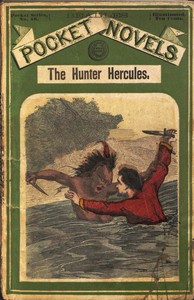
The catalog record for The Hunter Hercules, or, The Champion Rider of the Plains: A Romance of the Prairies — Key Ideas to Explore provides practical reading context through 36,643 words, 2 hr 40 min estimated reading time, and 5 detected text sections.
The text analysis averages about 17.8 words per sentence, while the detected sections provide another way to judge how the source is divided.
Project Gutenberg metadata also associates the work with “Western stories,” connecting these edition facts with the source record’s subject description.
Explore this collection
These alternatives are selected using recorded categories and estimated reading time.
About 159 minutes
Adventure Picaresque Fiction
36,503 recorded words. 1 minutes difference from this book's estimate.
View Gutenberg source #66231About 159 minutes
Adventure Picaresque Fiction
36,400 recorded words. 1 minutes difference from this book's estimate.
View Gutenberg source #68343About 158 minutes
Adventure Picaresque Fiction
36,247 recorded words. 2 minutes difference from this book's estimate.
View Gutenberg source #66190Search stored excerpts and compare books → Choose by your preferences →
Choices use stored catalog measurements. Estimates vary with reading speed. A shared category is a catalog label, not a claim that two books have the same argument or literary quality.
Search reads excerpt text stored with this catalog and links to its associated Gutenberg record. The connection is stored in the site database; this tool does not recheck that every excerpt is word-for-word identical to that external record. Excerpt search does not cover every chapter and does not verify historical publication dates.
Catalog snapshot checked: 2026-09-25. Coverage: 92 public books, 92 available source excerpts.
Read the complete public-domain text at its original source.
Read on Project GutenbergThe Hunter Hercules opens with a deliberate contrast between tailored frontier fashion and the wild prairie. The hero, Ralph, wears a suit of fine buck-skin made by a “regular” tailor, a detail that sets him apart from the old trappers. His felt hat is noted as “almost as effective as an umbrella,” a throwaway line that foreshadows the French naturalist’s signature accessory. The prairie itself is described in oceanic terms—the dry grass moved by the breeze “looked for all the world like the waves of the ocean.” This simile recurs, linking the landscape to a sea that the characters must navigate.
The French naturalist, Monsieur Tierney, is introduced as a man driven by scientific ambition. When he discovers a rare herb, he exclaims, “I am von famous man, an’ de society will make me dere President, vid a salary of thousands of francs.” His dialogue is rendered in a thick phonetic accent, marking him as an outsider among the American frontiersmen. The umbrella, initially a source of amusement for the trapper and Ralph, becomes a central prop. The text promises that before sunset, the umbrella will be “put to a use which for adaptability and a ludicrous sight had never been equaled before.” This sets up a specific payoff that the excerpts do not fully reveal, but the umbrella’s repeated mention signals its importance beyond mere comic relief.
The dialogue in the excerpts reveals three distinct registers. The trapper speaks in colloquial frontier dialect: “Jest like a romance, fur all the world.” Ralph, the young hunter, uses a more polished English, consistent with his tailored clothes. The naturalist’s French-accented speech, with phrases like “Sacré” and “Mon Dieu,” sets him apart. These linguistic differences create a layered social texture. The trapper’s speculation about Donna Iola’s identity—connecting her to a girl named Iola Montgomery—hints at a backstory that the excerpts do not confirm. The characters themselves are aware of the romance genre: the trapper explicitly compares Ralph’s rescue of Donna Iola to “a romance.”
The setting is not merely background but an active element. The prairie is “baked to a rich brown color,” and the grass moves like ocean waves. Chapter titles such as “A Wild Race for Life” and “Chased by the Flames” indicate that the landscape itself becomes a source of peril. The technique of “fighting fire with fire” is listed among the chapter headings, suggesting a survival strategy that the characters must employ. The Comanche chief Red Buffalo takes a “roundabout way” to his village to confuse pursuers, a tactic that the trapper deduces. This interplay of tracking and evasion is central to the plot, with the prairie offering both cover and danger.
Readers should pay attention to how the author uses material objects—the tailored buckskin, the umbrella, the herb case—to define character and advance the action. The naturalist’s scientific quest runs parallel to the hunter’s rescue mission, and both are tested by the same harsh environment. The excerpts leave several threads unresolved, including the fate of the umbrella exploit and the identity of Donna Iola. The novel rewards attention to these details, which are woven into the fabric of the dime-novel adventure.
I’ve always cherished that old Hunter Hercules, with its unlikely umbrella and its careful stitching of frontier pride. It reminds me of another quiet book, where the roads taken and the garments worn tell their own slow truths. Strange how different stories can share a seam. Here, too, is A Woman of Yesterday — Themes and Context, a gentler kind of reckoning with one’s own choices.
Save your reaction, strongest insight, and memorable passage.









