About 46 minutes
Creepin' Tintypes — Reading Notes
Adventure Picaresque Fiction
10,403 recorded words. 4 minutes difference from this book's estimate.
View Gutenberg source #66045
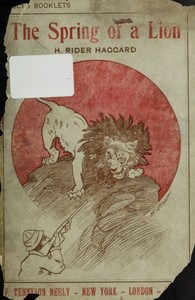
The catalog record for The Spring of a Lion — Reading Companion provides practical reading context through 9,576 words, 42 min estimated reading time, and 1 detected text section.
The text analysis averages about 24.8 words per sentence, while the detected sections provide another way to judge how the source is divided.
Project Gutenberg metadata also associates the work with “Short stories,” connecting these edition facts with the source record’s subject description.
Explore this collection
These alternatives are selected using recorded categories and estimated reading time.
About 46 minutes
Adventure Picaresque Fiction
10,403 recorded words. 4 minutes difference from this book's estimate.
View Gutenberg source #66045About 143 minutes
Adventure Picaresque Fiction
32,721 recorded words. 101 minutes difference from this book's estimate.
View Gutenberg source #66066About 143 minutes
Adventure Picaresque Fiction
32,733 recorded words. 101 minutes difference from this book's estimate.
View Gutenberg source #66157Search stored excerpts and compare books → Choose by your preferences →
Choices use stored catalog measurements. Estimates vary with reading speed. A shared category is a catalog label, not a claim that two books have the same argument or literary quality.
Search reads excerpt text stored with this catalog and links to its associated Gutenberg record. The connection is stored in the site database; this tool does not recheck that every excerpt is word-for-word identical to that external record. Excerpt search does not cover every chapter and does not verify historical publication dates.
Catalog snapshot checked: 2026-09-25. Coverage: 92 public books, 92 available source excerpts.
Read the complete public-domain text at its original source.
Read on Project GutenbergThe story opens with a frame: the narrator, identified as H. Rider Haggard, receives the tale from his old friend Allan Quatermain during a visit to Quatermain's Yorkshire home. Quatermain, we learn, has since vanished into the African interior on a quest for a white people, leaving only a single letter. The immediate scene is domestic—dinner, old port, and a room hung with hunting trophies—but the tone is elegiac, as the narrator suspects Quatermain will never return. This framing establishes the story as a last testament, a relic of a man already lost to the unknown.
The editorial note in the catalog lists The Spring of a Lion under “Adventure & Picaresque Fiction,” yet the excerpts reveal a structure more akin to a framed memoir. The opening pages are not action but recollection: Quatermain is introduced through Haggard’s eyes as “dear old man,” limping, with “gray hair sticking up in scrubbing-brush fashion” and “large dark eyes, that were as keen as any hawk's and yet soft as a buck's.” The story is told after dinner, prompted by wine, and the narrator explicitly notes that Quatermain was “not very fond of narrating his own adventures.” This framing device—a listener recording a spoken tale—shapes the reader’s experience, distancing the action and emphasizing the act of storytelling itself.
The central incident is a lion hunt in a kloof, where Quatermain’s rifle misfires at a critical moment. The catalog subjects include “Lion hunting – Fiction” and “Hunting stories,” but the excerpt focuses less on the kill than on the mechanical failure and Quatermain’s physical struggle. He describes trying to force a cartridge into the breech, “dashing my wrist and the palm of my hand against the brass rim … till the blood poured from them.” The scars remain visible as “seven or eight white cicatrices.” The lioness creeps forward, “lashing her tail,” while Quatermain walks backward, unable to load. The tension is built through precise, step-by-step description of the jammed cartridge—a detail that grounds the danger in a tangible, mundane object.
Quatermain’s voice is colloquial and direct, marked by exclamations like “Ah, you brute!” and “would you believe it?” He addresses his listeners as “you,” creating intimacy. His companion Tom, a Zulu or African assistant, plays a crucial role: it is Tom who shouts a warning when Quatermain is backing toward the wounded cub, and Tom who later kills the cub with an assegai. Yet the catalog subjects list only “Quatermain, Allan (Fictitious character) – Fiction,” omitting Tom’s significance. The excerpts show a collaborative hunt, not a solitary one. Tom’s advice—“You are walking on to the wounded cub; turn to the right”—saves Quatermain, and his decision to climb a tree is presented without judgment. The story’s dynamics are more communal than the catalog’s focus on a single character suggests.
The excerpts break off before the hunt concludes, leaving the fate of the three remaining lions unknown. Readers should attend to the frame’s melancholy—the knowledge that Quatermain, who survives this tale, is later lost. The story’s brevity (under 10,000 words) and its origin in a 1899 booklet series suggest it was meant for quick consumption, but the framing adds a layer of reflection uncommon in pure adventure. Treat the text as a spoken anecdote, not a novel; its power lies in the immediacy of Quatermain’s voice and the scarred hand he holds up as proof.
That old Quatermain story stays with me—how a single jammed cartridge can strip everything down to raw instinct. It made me think of another tale where the claws feel just as close, the stakes just as personal. Under the Tiger's Claws; Or, A Struggle for the Right — Background and Themes carries that same quiet weight, like a scar you keep turning over without meaning to.
Save your reaction, strongest insight, and memorable passage.









