About 143 minutes
Nat, The Trapper and Indian-Fighter — Key Ideas to Explore
Adventure Picaresque Fiction
32,721 recorded words. 0 minutes difference from this book's estimate.
View Gutenberg source #66066
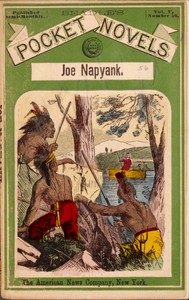
Joe Napyank; or, The River Rifles — Reading Notes can be approached with a clearer sense of reading commitment from its source measurements: 32,733 words, 2 hr 23 min estimated reading time, and 4 detected text sections.
The text analysis averages about 16.9 words per sentence, while the detected sections provide another way to judge how the source is divided.
Project Gutenberg metadata also associates the work with “Indians of North America -- Fiction,” connecting these edition facts with the source record’s subject description.
Explore this collection
These alternatives are selected using recorded categories and estimated reading time.
About 143 minutes
Adventure Picaresque Fiction
32,721 recorded words. 0 minutes difference from this book's estimate.
View Gutenberg source #66066About 144 minutes
Adventure Picaresque Fiction
32,923 recorded words. 1 minutes difference from this book's estimate.
View Gutenberg source #65629About 151 minutes
Adventure Picaresque Fiction
34,722 recorded words. 8 minutes difference from this book's estimate.
View Gutenberg source #68601Search stored excerpts and compare books → Choose by your preferences →
Choices use stored catalog measurements. Estimates vary with reading speed. A shared category is a catalog label, not a claim that two books have the same argument or literary quality.
Search reads excerpt text stored with this catalog and links to its associated Gutenberg record. The connection is stored in the site database; this tool does not recheck that every excerpt is word-for-word identical to that external record. Excerpt search does not cover every chapter and does not verify historical publication dates.
Catalog snapshot checked: 2026-09-25. Coverage: 92 public books, 92 available source excerpts.
Read the complete public-domain text at its original source.
Read on Project GutenbergThe novel opens with the hunter Joe Napyank dropping his rifle butt and announcing, “I’ve had a pretty good tramp to-day, that’s sartin!” His dialect—marked by “sartin,” “nigh unto,” and “a leetle blowed”—immediately establishes him as a seasoned frontiersman, lean and watchful. The setting is the Ohio River, described as rolling “in quiet grandeur,” and Joe’s scrutiny of a distant canoe reveals his purpose: he is waiting for someone named McGowan. The opening chapter thus primes the reader for a journey downriver, with Joe as a guide whose laconic observations set the tone for the adventure to come.
The first excerpt introduces Joe Napyank through his own words and physical description. He is “very tall and remarkably attenuated,” weighing barely a hundred pounds at six feet, with “features sharp and angular.” His speech is colloquial and self-assured, as when he identifies a distant speck as an Indian canoe “by the way it acts.” The river itself is a constant presence—broad, grand, and a stage for movement. Joe’s decision to wait on a tree trunk suggests a patient, observant protagonist. The prose is brisk, matching the dime-novel style, and the reader is drawn into a world where danger lurks beyond the next bend.
The middle excerpt abruptly shifts from Joe’s solitary watch to a scene of captivity. The Irishman Teddy O’Donnell and Ruth McGowan are prisoners in an Indian camp. Teddy’s voice is comic and defiant: he boasts of his pugilistic skill and addresses Ruth as “me jewil.” Ruth’s interiority is rendered with emotional weight—she recalls “the old man, Mr. Smith, springing up with his wild look” and feels “stricken with grief.” The narrative contrasts Teddy’s bluster with Ruth’s silent prayer, noting that “there was One who was ever nigh her.” This section introduces a second plotline and a different register, moving from action to pathos.
Teddy O’Donnell is a stock Irish character, speaking in a thick brogue (“Begorrah,” “be the powers”) and offering to fight his captors. His dialogue is peppered with threats and jokes, as when he tells the Indians to look at “them chaps’ noses” as ornaments. The narrative treats him as a source of humor, but also as a loyal companion—he reassures Ruth with a nod and a promise. The excerpt shows the dime novel’s reliance on ethnic stereotypes for comic effect, while also using Teddy to maintain a lighter tone amid the captivity drama. His presence contrasts with Joe’s more serious demeanor, suggesting the novel may alternate between these two registers.
The three excerpts reveal a pattern: the opening establishes a lone hunter and a river setting; the middle introduces a parallel captivity plot with emotional and comic elements; the later excerpt (not fully shown) likely returns to action. The table of contents confirms this structure, with chapters titled “On the Ohio,” “Night on the Ohio,” “Teddy O’Donnell and His Love Adventure,” and “On the Island.” The novel moves between Joe’s perspective and the captives’, building suspense through separation. The excerpts suggest that the reader should attend to shifts in voice—from Joe’s laconic observations to Teddy’s blarney—as clues to the novel’s episodic, picaresque nature.
Readers approaching Joe Napyank; or, The River Rifles should note that the excerpts offer only fragments of a larger adventure. The opening primes expectations for a river journey led by a gaunt hunter, while the captivity scenes introduce a second thread that may or may not converge with Joe’s. Teddy’s comic dialect and Ruth’s distress suggest the novel balances peril with levity. Pay attention to how the narrative shifts between characters and settings; the dime-novel format rewards quick reading and a tolerance for abrupt transitions.
That rainy afternoon, I kept returning to Joe Napyank’s voice—how it carried both roughness and a strange tenderness. Later, thinking about the loneliness of that frontier, I found myself reaching for Silverspur; or, The Mountain Heroine: A Tale of the Arapaho Country — Background and Themes, which seemed to answer the same quiet ache with a different kind of courage.
Your answers remain private and are stored only in this browser.









