About 143 minutes
Joe Napyank; or, The River Rifles — Reading Notes
Adventure Picaresque Fiction
32,733 recorded words. 0 minutes difference from this book's estimate.
View Gutenberg source #66157
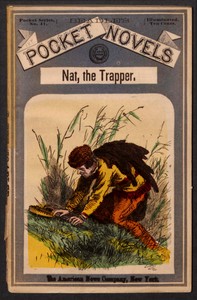
Before opening Nat, The Trapper and Indian-Fighter — Key Ideas to Explore, the edition data offers a quick orientation: 32,721 words, 2 hr 23 min estimated reading time, and 4 detected text sections.
The text analysis averages about 15.3 words per sentence, while the detected sections provide another way to judge how the source is divided.
Project Gutenberg metadata also associates the work with “Indians of North America -- Fiction,” connecting these edition facts with the source record’s subject description.
Explore this collection
These alternatives are selected using recorded categories and estimated reading time.
About 143 minutes
Adventure Picaresque Fiction
32,733 recorded words. 0 minutes difference from this book's estimate.
View Gutenberg source #66157About 144 minutes
Adventure Picaresque Fiction
32,923 recorded words. 1 minutes difference from this book's estimate.
View Gutenberg source #65629About 151 minutes
Adventure Picaresque Fiction
34,722 recorded words. 8 minutes difference from this book's estimate.
View Gutenberg source #68601Search stored excerpts and compare books → Choose by your preferences →
Choices use stored catalog measurements. Estimates vary with reading speed. A shared category is a catalog label, not a claim that two books have the same argument or literary quality.
Search reads excerpt text stored with this catalog and links to its associated Gutenberg record. The connection is stored in the site database; this tool does not recheck that every excerpt is word-for-word identical to that external record. Excerpt search does not cover every chapter and does not verify historical publication dates.
Catalog snapshot checked: 2026-09-25. Coverage: 92 public books, 92 available source excerpts.
Read the complete public-domain text at its original source.
Read on Project GutenbergThe opening pages of Nat, the Trapper and Indian-Fighter introduce Nathan Rogers—called Wild Nat—through a meticulous physical portrait: over six feet tall, with long limbs, deep-set gray eyes, a grizzled beard, and a nose of extraordinary length. He wears a dun-colored deer-skin suit and a coon-skin cap, and carries a long rifle, a buckhorn-handled knife, a powder-horn, and a tomahawk. This detailed description establishes him as a recognizable type from Beadle and Adams dime novels, yet the text quickly distinguishes him by his habit of speaking aloud to himself and his constant, suspicious scanning of the plain.
The narrative voice blends Nat’s colloquial dialect—phrases like “Gittin’ purty near noon” and “I’ll be a mere skileton”—with a third-person narrator who reports his actions with dry precision. This dual register creates a tension between the trapper’s rough exterior and the careful craft of the storytelling.
Wild Nat’s speech is the novel’s most distinctive feature. He uses nonstandard grammar and phonetic spelling: “I sw’ar I’m gittin’ e’ena’most famished,” “nary an Injun tew be seen,” and “Wagh!” as an exclamation. This dialect marks him as a frontier type, but it also generates humor, especially in his exchanges with Scip, an African American character. Nat mocks Scip’s fear during a chase, claiming his teeth chattered so loudly that the Indians followed the sound. Scip retorts, “It’s no such t’ing, Vic; he’s foolin’, he is!” but the narrator confirms the chattering. The teasing is relentless: Nat calls Scip’s headache a result of his teeth “dancing a double-shuffle” and threatens to scalp him if Indians “gobble” him up. Scip’s indignant replies—“Ye shet yer mouf!”—and his muttered grumbling when left alone reveal a character caught between fear and pride. The dynamic is one of unequal power—Nat is the skilled trapper, Scip the reluctant sidekick—but the dialogue gives Scip a voice that pushes back, however ineffectually.
The excerpts center on a chase and a cave. After a race through the forest, the fugitives reach a cave where Vic and Marion wait. Nat recounts the pursuit with relish: “I reckon they’ll feel ruther cantankerus about losin’ us so slick.” The cave functions as a temporary refuge, but the group’s vulnerability is underscored by the lack of a horse for Marion, a problem Vic calls “a poser.” Nat’s response—“perseverance an’ sweet ile will overcome any thin’”—is a comic non-solution that highlights his reliance on improvisation. The setting is sketched with minimal detail: a dell, a narrow gorge, a clump of timber. What matters is the spatial logic of hiding and escape. Nat’s watchfulness, his habit of scanning the plain, and his ability to vanish into darkness are the skills that keep the group alive. The geography is not picturesque but functional, a stage for the trapper’s cunning.
Despite Nat’s confident talk, the excerpts reveal a careful balance between courage and caution. He tells Scip to “keep a sharp eye out for reds” and then adds a dark joke about scalping him. When alone, Scip’s internal monologue betrays terror: “What’s dat black t’ing? Oh, de Lor’! S’pose it should be an Injun!” The narrative never lets the reader forget the real danger, even as it undercuts it with humor. Nat’s own bravery is demonstrated through action—he rides toward a grove with “intense watchfulness,” not recklessness. Yet his boasts (“Old Nat’s good for ’em yit”) and his laughter at Scip’s fear create a tone that is part adventure, part comedy. The dime novel formula demands a hero who is both competent and colorful, and the excerpts show Nat fulfilling that role while the text winks at the conventions. The result is a story that moves between genuine suspense and self-aware banter.
Readers approaching Nat, the Trapper and Indian-Fighter should attend to the interplay between Nat’s vernacular narration and the third-person frame. The novel’s humor depends on Scip’s fear and Nat’s mockery, but the threat of violence is never far away. The cave and the chase are set pieces that reveal character through action and dialogue. This is a work that rewards attention to its linguistic texture and its careful management of tone, even as it follows the familiar beats of the frontier dime novel.
I have always thought Wild Nat's gray-eyed watchfulness carries a loneliness beneath the jesting, and it is that same quiet solitude I find echoed in Joe Napyank; or, The River Rifles — Reading Notes. They sit together on the shelf like old comrades who never speak, yet understand the chill of a dark wood and the comfort of a steady rifle hand.
Your answers remain private and are stored only in this browser.









