About 223 minutes
The Transformation of Philip Jettan — A Reader’s Guide
Historical Psychological Social Fiction
51,238 recorded words. 5 minutes difference from this book's estimate.
View Gutenberg source #60776
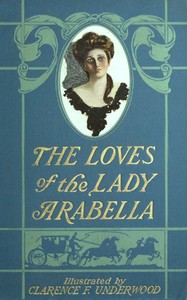
The catalog record for The Loves of the Lady Arabella — Background and Themes provides practical reading context through 50,073 words, 3 hr 38 min estimated reading time, and 13 detected text sections.
The text analysis averages about 22.3 words per sentence, while the detected sections provide another way to judge how the source is divided.
Project Gutenberg metadata also associates the work with “Inheritance and succession -- Fiction,” connecting these edition facts with the source record’s subject description.
Explore this collection
These alternatives are selected using recorded categories and estimated reading time.
About 223 minutes
Historical Psychological Social Fiction
51,238 recorded words. 5 minutes difference from this book's estimate.
View Gutenberg source #60776About 231 minutes
Historical Psychological Social Fiction
53,083 recorded words. 13 minutes difference from this book's estimate.
View Gutenberg source #64317About 202 minutes
Historical Psychological Social Fiction
46,414 recorded words. 16 minutes difference from this book's estimate.
View Gutenberg source #58344Search stored excerpts and compare books → Choose by your preferences →
Choices use stored catalog measurements. Estimates vary with reading speed. A shared category is a catalog label, not a claim that two books have the same argument or literary quality.
Search reads excerpt text stored with this catalog and links to its associated Gutenberg record. The connection is stored in the site database; this tool does not recheck that every excerpt is word-for-word identical to that external record. Excerpt search does not cover every chapter and does not verify historical publication dates.
Catalog snapshot checked: 2026-09-25. Coverage: 92 public books, 92 available source excerpts.
Read the complete public-domain text at its original source.
Read on Project GutenbergThe novel opens with fourteen-year-old Richard Glyn, a poor American relation, standing his ground in Lady Hawkshaw's Chinese drawing-room. Despite being a 'seeker after favor' with only seven and sixpence, he refuses to be cowed by her 'great black eyes' and nodding plume. This early scene establishes a pattern of defiance and class tension that runs through the narrative. Glyn's internal commentary on his mixed heritage—the 'honest, but plebeian' drysalter strain versus the 'rather more lofty than honest' baronet blood—signals a preoccupation with social standing and character that the excerpts repeatedly explore.
The first-person narration is distinctive for its frankness about social position. Richard Glyn, the speaker, is acutely aware of his ambiguous status: an American, a poor relation, and the product of both trade and gentility. He describes his great-grandfather as a drysalter and notes that his mother was 'of a high family and a baronet's daughter.' This self-consciousness colors his observations. When Lady Hawkshaw sends a message to her husband complaining of his 'roistering,' Glyn is disconcerted—he had expected the couple to live 'like doves in a cage.' Instead, he witnesses a marriage marked by blunt exchanges and mutual defiance. The narrator's voice is wry and self-aware, as when he reflects that the baronet strain was 'rather more lofty than honest.' This mixture of deference and critical distance gives the narrative a particular texture, one that questions the very hierarchies it describes.
The excerpts include a compressed account of five years at sea, during which Glyn serves under Nelson at the Nile and receives a scar that 'remains to this day.' The passage is notable for its matter-of-fact tone: 'We lived on beef and biscuit for months at a time; sometimes we had scurvy in the ship, and sometimes we did not.' The rhythm of the prose—short, parallel clauses—mirrors the relentless cycle of watch, chase, and battle. Glyn's pride is evident when he describes taking the frigate 'around the head of Admiral Villeneuve's line' and receiving 'the personal thanks of my Lord Nelson.' Yet the narrative also dwells on the cost: his friend Giles Vernon is captured and imprisoned at Dunkerque. The naval episodes function as a counterpoint to the drawing-room intrigues, offering a world where merit and action, rather than birth, determine standing.
Seawell structures key scenes as theatrical confrontations. The opening in Lady Hawkshaw's Chinese drawing-room is a carefully composed tableau: the 'vast black velvet robe like a pall,' the nodding plume, the tall footman making a grimace. The dialogue is formal and pointed. Lady Hawkshaw's speech—with its 'bowdwor' and 'Jeames'—is rendered as a marker of her character, at once imperious and slightly absurd. Later, when Glyn returns from sea, the same setting reappears: 'My Lady Hawkshaw was at home, and received me in great state, black feathers and all.' The repetition of the black feathers and the 'great state' suggests a ritualized performance of authority. These set pieces are balanced by quieter moments, such as the exchange with Daphne Carmichael, who speaks 'rather tartly' of Lady Arabella. The contrast between the formal, almost operatic scenes and the undercurrent of personal rivalry gives the novel its particular dramatic rhythm.
Readers should attend to the way Seawell uses the first-person narrator to mediate between two worlds: the hierarchical society of the English gentry and the more fluid, meritocratic realm of the navy. Glyn's observations are often ironic, but never dismissive. The excerpts suggest a novel that is as interested in the psychology of social climbing as in romantic intrigue. The incomplete text leaves many questions—about the fate of Giles Vernon, the outcome of Glyn's pursuit of Lady Arabella, and the resolution of his naval career—but the patterns of voice and structure are already clear.
Reading about Richard Glyn’s stiff-necked honesty against Lady Arabella’s glittering web brought me back to a rainy afternoon, the same ache of watching someone’s innocence meet a world that doesn’t blink. I found it once before, quieter, in Boy: A Sketch — Story, Setting & Ideas, where youth’s raw edges brushed against older, worn-in shadows. Both left me holding my breath, not for plot, but for the small, lost pauses between people. That feeling lingers, like a room after the lamp’s turned out.
Your answers remain private and are stored only in this browser.









