About 388 minutes
Quicksands — Context and Discussion
Historical Psychological Social Fiction
89,103 recorded words. 4 minutes difference from this book's estimate.
View Gutenberg source #65195
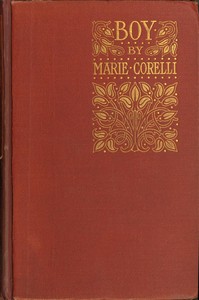
This digital edition of Boy: A Sketch — Story, Setting & Ideas is described by source-level measurements including 88,101 words, 6 hr 24 min estimated reading time, and 10 detected text sections.
The text analysis averages about 17.5 words per sentence, while the detected sections provide another way to judge how the source is divided.
Project Gutenberg metadata also associates the work with “England -- Fiction,” connecting these edition facts with the source record’s subject description.
Explore this collection
These alternatives are selected using recorded categories and estimated reading time.
About 388 minutes
Historical Psychological Social Fiction
89,103 recorded words. 4 minutes difference from this book's estimate.
View Gutenberg source #65195About 376 minutes
Historical Psychological Social Fiction
86,428 recorded words. 8 minutes difference from this book's estimate.
View Gutenberg source #68398About 393 minutes
Historical Psychological Social Fiction
90,311 recorded words. 9 minutes difference from this book's estimate.
View Gutenberg source #62418Search stored excerpts and compare books → Choose by your preferences →
Choices use stored catalog measurements. Estimates vary with reading speed. A shared category is a catalog label, not a claim that two books have the same argument or literary quality.
Search reads excerpt text stored with this catalog and links to its associated Gutenberg record. The connection is stored in the site database; this tool does not recheck that every excerpt is word-for-word identical to that external record. Excerpt search does not cover every chapter and does not verify historical publication dates.
Catalog snapshot checked: 2026-09-25. Coverage: 92 public books, 92 available source excerpts.
Read the complete public-domain text at its original source.
Read on Project GutenbergFrom its first chapter, Marie Corelli's 'Boy: A Sketch' establishes a tone of biting social observation through the infant protagonist's helpless perspective. The opening scene—a baby in a feeding-chair watching his father, 'Poo Sing,' stagger drunk—immediately sets up a world where adults fail children. Corelli's narrator intervenes with sardonic commentary, noting that 'if any truth exists' in theories about first impressions, then Boy had 'excellent cause to be profoundly disappointed.' This blend of childlike vulnerability and authorial irony recurs throughout the excerpts, as Boy's later experiences at a French school and in the South African War are filtered through a similarly disillusioned lens.
The novel's early chapters use Boy's infancy to expose adult hypocrisy without sentimentality. The baby's lisping concern for 'Poo Sing' contrasts grotesquely with the father's drunken stupor. Corelli describes the father's appearance with clinical precision: 'grizzled and wiry locks strayed in disorderly fashion across his inflamed nose and puffy eyelids.' This is not a softened portrait of childhood; Boy's 'large, angelic blue eyes' are juxtaposed with a domestic scene of neglect. The narrator's wry asides—calling the father 'a disreputable creature even at that'—prevent the reader from settling into easy sympathy. Instead, the child becomes a silent witness to adult failings, a role that will shape his later cynicism.
A recurring pattern in the excerpts is the failure of written communication. Miss Letty, Boy's affectionate guardian, receives a letter urging her to forget him, and she complies: 'she did not answer Mrs. D’Arcy-Muir’s letter, nor did she write to Boy.' Meanwhile, Boy's mother writes to him at school, twisting Miss Letty's silence into proof of disloyalty: 'I do not think Miss Leslie is as fond of you as she professed to be.' Boy reads this 'with the weary scorn that was becoming habitual with him.' The novel uses letters not as bridges but as weapons or evasions. Major Desmond's blunt epistle to Boy's father—calling the French schooling 'a d——d shame'—is intercepted by the mother and burned. Corelli thus builds a world where characters talk past each other, and silence becomes a form of betrayal.
The excerpts reveal a sharp tension between British and French models of upbringing. Major Desmond explicitly prefers 'an American education for girls to an English one' and condemns sending 'an upright-standing Briton into a French frog.' Boy himself, sent to France, reflects that 'if America was a funny place to send an English girl to school at, he thought France was a still funnier place for an English boy.' This cultural friction is not merely comic; it underscores the novel's concern with how institutions shape—or deform—character. The Major's advice to Boy's father—'look after your own affairs, and attend to the education of the little chap'—goes unheeded, suggesting that the adults who argue about pedagogy are themselves negligent. Corelli uses these contrasts to question whether any system can rescue a child from parental failure.
Readers approaching 'Boy: A Sketch' should attend to its layered ironies: the narrator's knowing tone, the gap between what characters say and what they do, and the way children perceive adult absurdities. Corelli does not offer easy resolutions; the excerpts end with Boy's scorn hardening. The novel rewards attention to its epistolary devices and its pointed cultural comparisons, which together build a critique of Edwardian society's treatment of the young.
There’s something about the way Corelli’s boy stumbles between innocence and ruin that lingers, much like Gatsby’s green light—both seem to be reaching for a version of themselves that never quite existed. I often think of that ache when I revisit The Great Gatsby — Text and Context, trailing its quiet, doomed hopes. Old books keep such strange company.
Answer a few questions and save a private reflection on this device.









