About 592 minutes
The Wyvern mystery — A Closer Reading
Historical Psychological Social Fiction
135,953 recorded words. 222 minutes difference from this book's estimate.
View Gutenberg source #68569
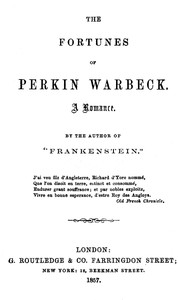
The source record for The Fortunes of Perkin Warbeck: a romance — Key Ideas to Explore measures this digital text at 187,209 words, 13 hr 34 min estimated reading time, and 20 detected text sections.
The text analysis averages about 26.5 words per sentence, while the detected sections provide another way to judge how the source is divided.
Project Gutenberg metadata also associates the work with “Historical fiction,” connecting these edition facts with the source record’s subject description.
Explore this collection
These alternatives are selected using recorded categories and estimated reading time.
About 592 minutes
Historical Psychological Social Fiction
135,953 recorded words. 222 minutes difference from this book's estimate.
View Gutenberg source #68569About 573 minutes
Historical Psychological Social Fiction
131,659 recorded words. 241 minutes difference from this book's estimate.
View Gutenberg source #65312About 535 minutes
Historical Psychological Social Fiction
122,959 recorded words. 279 minutes difference from this book's estimate.
View Gutenberg source #62902Search stored excerpts and compare books → Choose by your preferences →
Choices use stored catalog measurements. Estimates vary with reading speed. A shared category is a catalog label, not a claim that two books have the same argument or literary quality.
Search reads excerpt text stored with this catalog and links to its associated Gutenberg record. The connection is stored in the site database; this tool does not recheck that every excerpt is word-for-word identical to that external record. Excerpt search does not cover every chapter and does not verify historical publication dates.
Catalog snapshot checked: 2026-09-25. Coverage: 92 public books, 92 available source excerpts.
Read the complete public-domain text at its original source.
Read on Project GutenbergMary Shelley's The Fortunes of Perkin Warbeck opens not with the title figure but with the flight from Bosworth Field, immediately establishing a pattern of movement between battlefields, courts, and coastlines. The narrative structure, divided into fifty-eight chapters, traces Warbeck's progress through a series of conferences, challenges, and escapes, each scene shift marked by a change in setting—from the Tower to Scotland, from Cork to Cornwall. Shelley uses recurring images of vessels and voyages: the Adalid appears as a threshold between departure and separation, while jewels and plate function as tokens of allegiance and loss. The prose voice oscillates between panoramic historical narration and intimate interior monologue, as seen in Monina's extended reverie, where she resolves to 'paint my face with joy's own hue' while concealing her despair.
The novel's structure is built on a series of physical transitions: from Bosworth Field to the conference, from the French court to Scotland, from Ireland to Cornwall. Each chapter heading signals a new location or event—'The Landing at Cork,' 'The March towards England,' 'The Siege of Waterford'—creating a rhythm of approach and retreat. These movements are not merely geographical; they mark shifts in Warbeck's fortunes, as when he 'visited his vessels, and saw that all was in readiness' before embarkation. The threshold between land and sea becomes a recurring motif, with ships like the Adalid representing both opportunity and separation. Shelley lingers on the moment of departure, as when De Faro's vessel is prepared for 'the untrod watery deserts,' emphasizing the precariousness of each crossing.
Throughout the excerpts, material objects carry symbolic weight. The 'treasure his aunt had bestowed' includes 'services of valuable plate and valuable jewels,' gifts that signify political alliance and personal affection. These items are not mere props; they are carefully inventoried, as when the narrator notes 'a considerable sum of money' alongside plate and jewels. The countess's 'peculiar friendship for the Spanish maiden, Monina' is likewise marked by gifts and hospitality. Shelley uses these tokens to anchor abstract loyalties in tangible form. When Monina resolves to accompany her father, she imagines his 'dark eyes will flash with joy' at the prospect of adding the De Faro name to explorers' lists—a different kind of treasure, one of reputation and legacy.
Shelley grants extended interior monologue to characters, most notably Monina, whose reverie occupies several paragraphs. This passage reveals a pattern of self-suppression: 'I will not enrich the tell-tale air by one sigh; nor through my broken heart shall the gloom of my despair appear.' The language of concealment—'garnered up in my own heart, watched with a miser's care'—echoes the novel's broader concern with hidden identities and unspoken motives. Warbeck himself is a figure of disputed origin, and the narrative voice often withholds direct judgment, allowing characters to articulate their own doubts and resolutions. Monina's speech is punctuated by exclamations ('Alas!', 'Spotless Mother of God') that heighten the emotional intensity while remaining within the bounds of historical decorum.
Beyond the central figures, Shelley populates the novel with a network of supporters and observers: 'Above a hundred knights graced his train,' and 'many remained of noble birth and good renown.' These collective presences function as a kind of chorus, their 'dissentient voice' notably absent as preparations proceed. The countess of Desmond and her family provide hospitality, while De Faro represents a parallel narrative of exploration. Even minor figures like Frion, who reports words that might provoke conflict, serve to advance the plot through information exchange. This ensemble structure prevents the story from becoming a solitary biography; instead, Warbeck's fortunes are embedded in a web of relationships, each character's choices—like Monina's decision to sail—rippling outward.
Readers attentive to Shelley's handling of scene transitions will notice how each chapter break functions as a pivot, often ending with a decision or a departure. The recurring image of the ship—poised between land and open water—encapsulates the novel's central tension between rooted identity and the lure of new beginnings. As you move through the fifty-eight chapters, observe how the prose shifts between panoramic description and concentrated interiority, and how objects like jewels or letters carry the weight of unspoken bonds.
There’s something about lingering with a lost cause—Perkin Warbeck’s quiet resolve, how he carries his jewels and ships like heavy memories. It reminded me of another story where limitation becomes its own kind of sacrifice. Limitations: A Novel — Key Ideas to Explore stayed with me that way, like a tide you don’t notice until it’s gone out. Just a thought, sitting here with you.
Your answers remain private and are stored only in this browser.









