About 573 minutes
The Divine Lady: A Romance of Nelson and Emma Hamilton — Edition Insights
Historical Psychological Social Fiction
131,659 recorded words. 19 minutes difference from this book's estimate.
View Gutenberg source #65312
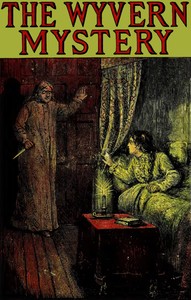
The Wyvern mystery — A Closer Reading can be approached with a clearer sense of reading commitment from its source measurements: 135,953 words, 9 hr 52 min estimated reading time, and 13 detected text sections.
The text analysis averages about 18.6 words per sentence, while the detected sections provide another way to judge how the source is divided.
Project Gutenberg metadata also associates the work with “Orphans -- Fiction,” connecting these edition facts with the source record’s subject description.
Explore this collection
These alternatives are selected using recorded categories and estimated reading time.
About 573 minutes
Historical Psychological Social Fiction
131,659 recorded words. 19 minutes difference from this book's estimate.
View Gutenberg source #65312About 535 minutes
Historical Psychological Social Fiction
122,959 recorded words. 57 minutes difference from this book's estimate.
View Gutenberg source #62902About 479 minutes
Historical Psychological Social Fiction
110,156 recorded words. 113 minutes difference from this book's estimate.
View Gutenberg source #59963Search stored excerpts and compare books → Choose by your preferences →
Choices use stored catalog measurements. Estimates vary with reading speed. A shared category is a catalog label, not a claim that two books have the same argument or literary quality.
Search reads excerpt text stored with this catalog and links to its associated Gutenberg record. The connection is stored in the site database; this tool does not recheck that every excerpt is word-for-word identical to that external record. Excerpt search does not cover every chapter and does not verify historical publication dates.
Catalog snapshot checked: 2026-09-25. Coverage: 92 public books, 92 available source excerpts.
Read the complete public-domain text at its original source.
Read on Project GutenbergThe Wyvern Mystery opens with a specific, domestic scene: Alice Maybell, wrapped in furs, prepares to leave her aunt's house for Wyvern, anxious about displeasing 'old Mr. Fairfield, the Squire.' The narrative voice immediately establishes a tension between affection and fear, as Alice blushes when asked which Mr. Fairfield she means. This early moment, with its focus on a young woman's constrained position, sets the tone for a story that, based on the excerpts, revolves around secrets, letters, and hurried departures rather than overt gothic horror.
The Project Gutenberg catalog lists eight subjects for this novel, including 'Orphans -- Fiction,' 'Inheritance and succession -- Fiction,' 'Fathers and sons -- Fiction,' and 'Conflict of generations -- Fiction.' However, the excerpts provided offer only partial support for these categories. Alice Maybell is an orphan living with an aunt, but the text does not dwell on her orphan status. The theme of inheritance is hinted at through the Fairfield family's estate, but no explicit dispute over succession appears in the excerpts. Similarly, 'fathers and sons' is not directly depicted; the old Squire is mentioned, but his relationship with his sons is not shown. The catalog's inclusion of 'Domestic fiction' and 'Psychological fiction' aligns better with the excerpts, which focus on personal anxieties, secret plans, and interpersonal manipulation.
The excerpts are dominated by the logistics of concealment and escape. A character named Ry writes two letters: one to 'my darling little Woman' (Alice) instructing her to pack and meet him at Lonsdale, and another to Harry, revealing that a threatening 'person' has arrived at Carwell Grange, mistaking Harry for the married man. The letters are filled with precise instructions—'Drive to Wykeford and change horses there,' 'Leave all in charge of old Mildred'—and a palpable sense of urgency. The narrative lingers on Ry's calculations: 'he had a hundred pounds in his pocket-book,' 'scarcely five hundred pounds a year.' This focus on practical arrangements, rather than emotional turmoil, suggests a story driven by plot mechanics and the pressure of immediate decisions.
The excerpts reveal a narrator who shifts between close third-person perspective and direct, almost epistolary passages. The opening chapter presents Alice's dialogue and internal feelings, but the later sections are dominated by Ry's thoughts and his letters, which are quoted in full. This structural choice gives the reader direct access to the characters' plans and deceptions. The prose is economical, with short paragraphs and frequent use of dashes for emphasis. The setting is conveyed through small details—'the dull light of the mutton-fat' candle, 'a pretty little German village' remembered vividly—rather than extended description. The gothic elements cataloged under 'horror-gothic' are minimal in these excerpts, appearing only in chapter titles like 'The Omen of Carwell Grange' and 'Mildred Tarnley's Warning Story,' which are not included in the provided text.
Readers approaching The Wyvern Mystery through this digital edition should note that the excerpts represent only a fraction of the novel's 135,000 words. The catalog subjects may overstate certain themes, while the gothic label is barely evident in the available text. Pay attention to the letters and the characters' constant calculations—they are the engine of the plot. The novel's interest lies less in supernatural mystery than in the psychological pressures of inheritance, secrecy, and constrained choice.
Reading through the Fairfield inheritance tensions in The Wyvern Mystery, I found myself wistfully recalling Halfway House: A Comedy of Degrees — Background and Themes. Both books linger on generational friction, yet the latter’s tone feels lighter, more forgiving. It’s curious how one family’s gloom can quietly summon another’s gentle wit, as if memory pairs shadow with soft sunlight.
Answer a few questions and save a private reflection on this device.









