About 152 minutes
Mad Anthony's scouts; or, The rangers of Kentucky — Inside the Classic
Adventure Picaresque Fiction
34,941 recorded words. 1 minutes difference from this book's estimate.
View Gutenberg source #68482
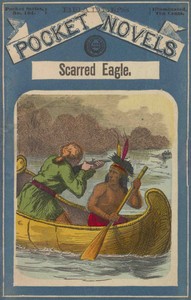
Before opening Scarred Eagle; or, Moorooine, the sporting fawn. A story of lake and shore — Reading Notes, the edition data offers a quick orientation: 34,722 words, 2 hr 31 min estimated reading time, and 15 detected text sections.
The text analysis averages about 13.9 words per sentence, while the detected sections provide another way to judge how the source is divided.
Project Gutenberg metadata also associates the work with “Indians of North America -- Fiction,” connecting these edition facts with the source record’s subject description.
Explore this collection
These alternatives are selected using recorded categories and estimated reading time.
About 152 minutes
Adventure Picaresque Fiction
34,941 recorded words. 1 minutes difference from this book's estimate.
View Gutenberg source #68482About 154 minutes
Adventure Picaresque Fiction
35,244 recorded words. 3 minutes difference from this book's estimate.
View Gutenberg source #68513About 157 minutes
Adventure Picaresque Fiction
36,019 recorded words. 6 minutes difference from this book's estimate.
View Gutenberg source #64036Search stored excerpts and compare books → Choose by your preferences →
Choices use stored catalog measurements. Estimates vary with reading speed. A shared category is a catalog label, not a claim that two books have the same argument or literary quality.
Search reads excerpt text stored with this catalog and links to its associated Gutenberg record. The connection is stored in the site database; this tool does not recheck that every excerpt is word-for-word identical to that external record. Excerpt search does not cover every chapter and does not verify historical publication dates.
Catalog snapshot checked: 2026-09-25. Coverage: 92 public books, 92 available source excerpts.
Read the complete public-domain text at its original source.
Read on Project GutenbergThe opening rifle shots in Scarred Eagle; or, Moorooine, the sporting fawn establish a pattern of pursuit that governs the novel's action. Two canoes race across Lake Erie, one carrying a white scout and an Indian named Goodbrand, the other five Indian warriors. The scout's face is marked by a single large scar, earning him the name Scarred Eagle among Indians who both fear and respect him. His hunting-frock bears a beadwork design of a man carrying a white female prisoner from sleeping Indians—a detail that signals the story's preoccupation with captivity and rescue. The narrative voice shifts between dialogue marked by dialect and descriptive passages that linger on physical details: the calm bosom of the lake, the distance of bullets, the odds of five oars against two.
The excerpts repeatedly place characters in hiding, forcing them to rely on sound and inference rather than direct vision. Scarred Eagle and Moorooine crouch in a loft above a council-house, peering through a crevice to gauge the movements of searchers below. The text emphasizes the gloom of the space and the time needed for eyes to adjust. Moorooine listens to excited conversation and translates it for the scout: the Indians believe the canoe is gone and that the fugitives have escaped. But one warrior suspects the loft has not been searched. The scene turns on what can be heard, glimpsed, and guessed—a pattern that recurs throughout the excerpts. The scout's hope depends on the searchers' failure to look closely enough, and on the superstitious notions that make them abandon certain lines of inquiry.
Scarred Eagle's speech is marked by contractions and frontier idiom: “Pull for y’ur life,” “Thar’s jist a hope,” “Ye’ve put y’ur life at stake.” Yet the narrator insists on his dignity, calling him “one of nature’s noblemen” and noting the “bold, frank style of the man’s speech.” The scarred face is described as “not wanting in expression,” and his gray eye meets strangers without evasion. This tension between rough dialect and elevated characterization suggests a deliberate crafting of the scout as a figure of natural authority. Moorooine's speech is rendered with similar dialect features—“S’pose white friends safe too—all safe?”—but she is also credited with quick understanding and tactical insight. The dialogue carries much of the plot's forward motion, with characters interpreting events through short, urgent exchanges.
Lake Erie, the river, the subterranean passage, and the village council-house all function as specific, named locations that shape the action. The chase begins on open water, where distance and speed are measured in rods and oars. Later, the characters hide in a loft above the council-house, and the scout recalls a “dark passage” in the river where he hopes the rangers have taken cover. Moorooine calls it a place where a “bad spirit lives,” but the scout dismisses the superstition. The landscape is not merely backdrop; it offers both obstacles and opportunities for concealment. The canoe's disappearance becomes a piece of evidence that the Indians interpret as escape, buying the fugitives time. The text uses these settings to create a geography of tension, where every feature—a crevice, a beam, a riverbank—can become a hiding place or a trap.
Readers attentive to the interplay of speech and silence will find that the novel's drama often unfolds in what is not said or seen. The excerpts reward close attention to the physical positions of characters—who is above, below, hidden, or exposed—and to the way knowledge is parceled out through whispers and half-glimpsed movements. The story's pace is driven by the gap between what the pursuers believe and what the reader knows, a gap that narrows and widens with each new discovery.
There’s a shadowy kinship between Scarred Eagle and Ben, the Trapper; Or, The Mountain Demon: A Tale of the Black Hills — Key Ideas to Explore, both huddled close to the land’s breath, listening. One reads of a scarred scout’s stillness by the lake; the other feels that same held quietude among pines. Old companions in vigilance, never quite at rest.
Your answers remain private and are stored only in this browser.









