About 151 minutes
Scarred Eagle; or, Moorooine, the sporting fawn. A story of lake and shore — Reading Notes
Adventure Picaresque Fiction
34,722 recorded words. 1 minutes difference from this book's estimate.
View Gutenberg source #68601
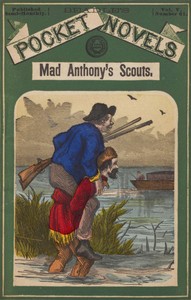
Before opening Mad Anthony's scouts; or, The rangers of Kentucky — Inside the Classic, the edition data offers a quick orientation: 34,941 words, 2 hr 32 min estimated reading time, and 4 detected text sections.
The text analysis averages about 18.7 words per sentence, while the detected sections provide another way to judge how the source is divided.
Project Gutenberg metadata also associates the work with “Indians of North America -- Fiction,” connecting these edition facts with the source record’s subject description.
Explore this collection
These alternatives are selected using recorded categories and estimated reading time.
About 151 minutes
Adventure Picaresque Fiction
34,722 recorded words. 1 minutes difference from this book's estimate.
View Gutenberg source #68601About 154 minutes
Adventure Picaresque Fiction
35,244 recorded words. 2 minutes difference from this book's estimate.
View Gutenberg source #68513About 157 minutes
Adventure Picaresque Fiction
36,019 recorded words. 5 minutes difference from this book's estimate.
View Gutenberg source #64036Search stored excerpts and compare books → Choose by your preferences →
Choices use stored catalog measurements. Estimates vary with reading speed. A shared category is a catalog label, not a claim that two books have the same argument or literary quality.
Search reads excerpt text stored with this catalog and links to its associated Gutenberg record. The connection is stored in the site database; this tool does not recheck that every excerpt is word-for-word identical to that external record. Excerpt search does not cover every chapter and does not verify historical publication dates.
Catalog snapshot checked: 2026-09-25. Coverage: 92 public books, 92 available source excerpts.
Read the complete public-domain text at its original source.
Read on Project GutenbergThe story opens with a campfire meeting between Hezekiah Smith, a laconic backwoodsman, and Pat Mulroony, an Irishman who explains his presence with the deadpan line, “Me legs.” Their guarded exchange—each hints at a secret history—establishes a pattern of withheld information that runs through the book. The narrative quickly shifts to a third figure, Waring, who is tracking a Shawnee war party that has taken a captive. The Ohio River becomes a central stage: canoes, flatboats, and the shoreline are repeatedly described, and Waring’s pursuit hinges on reading the river’s currents and the Indians’ movements. The prose moves between broad dialect comedy and tense, detail-oriented tracking sequences, giving the book a dual rhythm of banter and vigilance.
The first chapter introduces two characters who speak in markedly different vernaculars. Hezekiah Smith uses a deliberate, questioning cadence—“Haow dew yeou dew, cap.?”—while Pat Mulroony replies with stage-Irish flourishes: “Faith, I'm an adventoorer, as the convict said.” Their conversation is a game of evasion. Smith presses for Pat’s motive; Pat deflects with a joke. The narrator notes that “both of these characters had a secret history—a history which each was determined should remain a secret.” This mutual concealment is not resolved in the excerpt, and it sets up a structural tension: the reader knows these men are hiding something, but the story withholds the nature of their secrets. The dialogue is the primary vehicle for characterization, and the exaggerated dialects signal that this is a dime novel aiming for broad, immediate effect rather than psychological depth.
Waring’s pursuit of the Shawnee war party is the book’s central action, and the excerpts show a methodical attention to the physical details of tracking. He examines the ground on one side of a fire, finds nothing, then switches to the opposite side and discovers the trail. The narrator explains that the Shawnees’ carelessness—they “straggled forward as carelessly as a party of schoolboys”—is the only reason Waring can follow them. This emphasis on the absence of signs as much as their presence gives the tracking sequences a forensic quality. Waring’s internal reasoning about the river crossing is laid out step by step: he considers whether the Shawnees went up, down, or across, weighs the likelihood that their home is in southern Ohio, and decides to cross. The prose slows to match his deliberation, then quickens when he spots the canoe. The rhythm of the narrative is thus tied to the pace of the chase.
The Ohio River is not just a setting but a dynamic element that shapes the plot. Characters move between the shore, flatboats, and canoes. Waring’s pursuit is described in terms of the river’s geography: he runs along the bank, loses sight of the canoe “behind a bend,” and must guess the Indians’ direction. The river offers multiple possibilities—upstream, downstream, or across—and Waring’s choices are presented as gambles. The flatboat appears as a site of plunder when Shawnees search it for goods, and the canoe is described as “skimming like a swallow.” The water itself is a medium of both danger and opportunity: it allows the Shawnees to move quickly, but it also leaves traces that Waring can read. The excerpts do not reveal whether Waring’s guess is correct, leaving the outcome suspended.
Fire appears in multiple contexts: the campfire where Smith and Mulroony meet, described as “smouldering”; the fire that Waring examines for signs of the Shawnees; and the implied fires of Indian villages. The campfire is a point of safety and social contact, but it also draws attention—Mulroony notes that a visible fire could belong to “a band of haythen” who don’t care who sees it. Light and visibility are recurring concerns: Waring watches the canoe from the cover of woods, and the narrative notes when he is “not observed.” The contrast between open fire and hidden observation structures several scenes. The excerpts do not describe night scenes in detail, but the emphasis on seeing and being seen suggests that darkness and concealment will play a role in later action.
The excerpts offer a clear picture of the book’s dual interests: comic dialogue between mismatched companions and a tense, linear pursuit. Readers should note that the narrative voice shifts between broad dialect humor and a more neutral, almost procedural tone during the tracking sequences. The river is the central geographic feature, and the story’s momentum depends on Waring’s ability to interpret its currents and the Indians’ movements. The secrets hinted at in the opening are not resolved in the available text, and the outcome of the chase remains unknown.
There’s a quiet kinship between Mad Anthony's scouts and Old Bear-Paw, the trapper king; or, The love of a Blackfoot queen — Story, Setting & Ideas—both understand how the wilderness bends a man’s heart toward strange loyalties. I recall Waring’s grim chase, never quite drowning out Hezekiah’s fiddle; one almost expects Old Bear-Paw to step from those same campfire shadows, carrying a different kind of bargain.
Build a private reading journal entry for this title.









