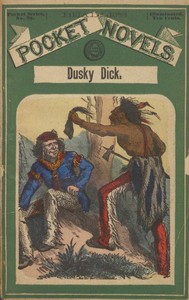
From its opening line, Jos. E. Badger's 1872 dime novel establishes a pattern of surveillance and concealed approach. Old Edward Wilson spots a figure coming up the spring path, and the reader is immediately placed inside a cabin doorway, watching an intruder draw near. This vantage point—characters observing others from cover or hiding—recurs throughout the excerpts, creating a structural rhythm of approach, discovery, and flight.
The novel's title character, Dusky Dick, is introduced through his peculiar skin tint, a physical trait that sets him apart and gives him his nickname. Badger lingers on this detail, noting that even those who knew him might not recall another name. This emphasis on a single, defining characteristic is typical of the dime novel's shorthand characterization, but it also signals that Dick's appearance will be a recurring touchstone in the narrative.
Moonlight and Concealment
The excerpts are saturated with moonlight. The full moon reveals Dusky Dick's features in the opening chapter, and later, the same light illuminates the path for fugitives and pursuers alike. Badger uses moonlight not as static backdrop but as an active element in the plot: it exposes characters to danger, forces them to crouch in shadows, and creates a visual contrast between the silver-lit trail and the dark underbrush where characters hide.
This interplay of light and concealment structures several key scenes. When Fred and his companions hear approaching footsteps, they “crouched down amid the bushes” while the pattering sound draws nearer. The moonlight would have betrayed them had they not found cover. Badger repeatedly stages such moments of held breath, where the narrative pauses on the verge of discovery. The result is a series of small, tense tableaux that build cumulative suspense.
Fire as a Signal of Disaster
Fire appears as a harbinger of catastrophe. Fred sees the sky reddening and knows immediately that his cabin is burning. The conflagration is not described in detail; instead, Badger focuses on its effect: the “fast widening trace” of light, the “shrill yells” carried on the wind. Fire here is less a physical event than a sign that plans have failed, that the enemy has already struck.
This use of fire as a distant, ominous signal recurs in the structure of the narrative. Characters often perceive danger at a remove—through sound, light, or the absence of expected noise. When Fred hears no shooting, he fears the worst. The novel thus builds tension not through direct confrontation but through the interpretation of sensory clues, a technique that keeps the reader attuned to the same cues as the characters.
Movement Between Groups
The excerpts show a narrative that cuts between multiple parties moving through the same landscape. Fred and his group try to reach the Wilson cabin, while Sloan Young's gang passes them on the trail, and Dusky Dick's gang is said to be somewhere nearby. This crisscrossing of paths creates a web of potential encounters, each with different stakes.
Badger signals these shifts through changes in focal character. The opening chapter centers on the Wilson cabin; later, the perspective moves to Fred, then to the fugitives he guides. Each shift is marked by a new set of anxieties: will the cabin be attacked? Has John Stevens succeeded in his errand? Where is Dusky Dick? The narrative does not resolve these questions immediately, instead letting them accumulate. This technique, common in serial fiction, keeps multiple threads alive simultaneously and rewards attention to who is where and when.
The Scout's Role as Intermediary
Fred, the young settler who guides the fugitives, occupies a distinctive position in the novel's structure. He is not a main character like Dusky Dick, but he functions as a bridge between the threatened settlers and the dangerous landscape. His knowledge of the trail, his ability to read signs, and his caution mark him as an experienced frontiersman, yet he is also vulnerable—his own cabin is burned, and he must rely on stealth rather than force.
Badger gives Fred a modest, almost reluctant authority. When Stevens urges haste, Fred insists on caution: “I have had more experience in these matters than you have.” This dynamic recurs in dime novels, where the scout or woodsman often mediates between the reader and the wilderness. Fred's repeated warnings—to stay hidden, to wait, to move quietly—anchor the narrative's tension in practical survival skills rather than heroic bravado.
Readers should pay close attention to the novel's use of sensory detail—what characters hear, see, and fail to see. Badger often withholds direct description of violence, instead letting the reader infer danger from a reddening sky or a distant yell. The result is a story that moves quickly but rewards careful reading of its cues. The excerpts suggest that Dusky Dick is less a straightforward adventure than a series of near-misses and narrow escapes, structured around the constant threat of discovery.
I’ve watched readers set down Dusky Dick and grow quiet, thinking about what moves unseen in firelight. There is a kindered weight in its pages, a shadowy watchfulness, that I find again in Wolf-Cap; or, The Night-Hawks of the Fire-Lands: A Tale of the Bloody Fort — Reading Companion—two old friends who know how to keep a secret until dawn.