About 173 minutes
Silverspur; or, The Mountain Heroine: A Tale of the Arapaho Country — Background and Themes
Adventure Picaresque Fiction
39,623 recorded words. 3 minutes difference from this book's estimate.
View Gutenberg source #57589
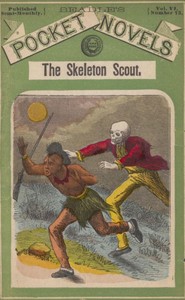
Before opening The skeleton scout; or, The border block — Story, Setting & Ideas, the edition data offers a quick orientation: 40,275 words, 2 hr 56 min estimated reading time, and 4 detected text sections.
The text analysis averages about 13.4 words per sentence, while the detected sections provide another way to judge how the source is divided.
Project Gutenberg metadata also associates the work with “Indians of North America -- Fiction,” connecting these edition facts with the source record’s subject description.
Explore this collection
These alternatives are selected using recorded categories and estimated reading time.
About 173 minutes
Adventure Picaresque Fiction
39,623 recorded words. 3 minutes difference from this book's estimate.
View Gutenberg source #57589About 172 minutes
Adventure Picaresque Fiction
39,404 recorded words. 4 minutes difference from this book's estimate.
View Gutenberg source #66085About 171 minutes
Adventure Picaresque Fiction
39,138 recorded words. 5 minutes difference from this book's estimate.
View Gutenberg source #65087Search stored excerpts and compare books → Choose by your preferences →
Choices use stored catalog measurements. Estimates vary with reading speed. A shared category is a catalog label, not a claim that two books have the same argument or literary quality.
Search reads excerpt text stored with this catalog and links to its associated Gutenberg record. The connection is stored in the site database; this tool does not recheck that every excerpt is word-for-word identical to that external record. Excerpt search does not cover every chapter and does not verify historical publication dates.
Catalog snapshot checked: 2026-09-25. Coverage: 92 public books, 92 available source excerpts.
Read the complete public-domain text at its original source.
Read on Project GutenbergThe first chapter of The Skeleton Scout; or, The Border Block opens with a scene of stealth and menace: ten Indians, led by a chief in plumed headdress, glide through a forest toward a fortified cabin. The prose is brisk, relying on visual cues—war-paint, breech-cloth, English rifles—to establish the frontier setting. Yet the narrative quickly complicates this straightforward threat. A man on guard paces the riverbank, and then “a strange sight” appears, though the excerpt cuts off before revealing it. This early interruption forces the reader to rely on the title’s promise of a skeleton scout, hinting that the novel may blend historical adventure with gothic horror.
In a later excerpt, the aftermath of an attack introduces a different kind of uncertainty. Floyd, a young soldier, finds his father with a fractured skull. Seth, the Yankee scout, diagnoses the injury with grim pragmatism: “I’ve seen that kind of a hurt afore and they ain’t no good.” The father, Captain Floyd, awakens disoriented, speaking of “a fellow I had some trouble with this morning” and demanding silence. His dialogue shifts between lucidity and delusion—he claims Venus is a friend, then fixates on a hat. Seth’s whispered “Cracked” and the men’s understanding signal that the wound has caused madness. The reader must decide whether the captain’s rambling is purely physical or if it hints at supernatural possession, a question the novel leaves open.
Seth, the Yankee scout, speaks in a distinct vernacular that sets him apart from the more formal dialogue of Floyd and the captain. His lines are peppered with contractions and colloquialisms: “yew go and look arter the gal,” “I daren’t touch that wound,” “Thar; he’s coming round.” This dialect not only marks his regional origin but also his role as a pragmatic, unsentimental observer. When the captain rambles about planets, Seth responds with deadpan humor: “That’s right, captaing. If any of them refuse to obey, you’d better order him forty lashes.” The contrast between Seth’s earthy speech and the captain’s grandiose delusions creates a tonal friction that keeps the reader alert to shifts between tragedy and dark comedy.
Amid the chaos of the wounded captain, Floyd suddenly remembers “the gal.” He “started up eagerly and hurried away,” but the excerpt does not reveal whether he finds her. This offhand reference to a female character—unnamed, unmentioned before—introduces a plot thread that the narrative treats as urgent yet secondary. The reader, like Floyd, is left to wonder: Who is she? Is she captive, dead, or hiding? The lack of context forces a first-time reader to hold this question in mind, trusting that later chapters will provide answers. The novel’s structure, as glimpsed here, relies on such dangling threads to propel the action forward, even as the immediate crisis (the father’s madness) dominates the scene.
The excerpts reveal a work that shifts rapidly between genres. The opening is a classic frontier ambush scene, complete with Tecumseh’s warriors and a stockade. The middle excerpt veers into psychological horror as the captain’s fractured skull produces hallucinations. Yet Seth’s dry humor undercuts the pathos: “That is the funniest hat, as I’m alive.” The novel’s subtitle, “The Border Block,” suggests a physical obstacle, but the real block may be the reader’s inability to pin down the story’s mode. Is this a ghost story, a historical adventure, or a character study of trauma? The excerpts resist easy classification, and a first-time reader should expect the unexpected—including moments of absurdity that challenge the grim setting.
Readers approaching The Skeleton Scout for the first time should pay close attention to the gaps in the narrative: the interrupted “strange sight,” the unnamed woman, the captain’s ambiguous madness. These ellipses are not flaws but deliberate devices that create suspense. The novel rewards a patient reader who is willing to sit with uncertainty, letting the dime novel’s brisk pacing and shifting tones carry them through a story that refuses to settle into a single genre.
That rainy afternoon, The Skeleton Scout kept slipping between frontier bravado and uneasy shadows, leaving me unsure what was real. I shut it, staring at rain on glass, and wondered what happens to a man after the adventure ends. Later, almost without thinking, I reached for another book—His Great Adventure — Context and Discussion—and found that same quiet question waiting there, softer, older.
Build a private reading journal entry for this title.









