About 173 minutes
Silverspur; or, The Mountain Heroine: A Tale of the Arapaho Country — Background and Themes
Adventure Picaresque Fiction
39,623 recorded words. 1 minutes difference from this book's estimate.
View Gutenberg source #57589
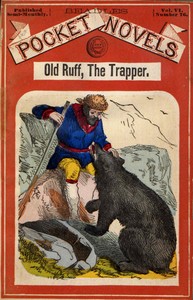
This digital edition of Old Ruff, the Trapper; or, The Young Fur-Hunters — Reading Companion is described by source-level measurements including 39,404 words, 2 hr 52 min estimated reading time, and 5 detected text sections.
The text analysis averages about 24.6 words per sentence, while the detected sections provide another way to judge how the source is divided.
Project Gutenberg metadata also associates the work with “Indians of North America -- Fiction,” connecting these edition facts with the source record’s subject description.
Explore this collection
These alternatives are selected using recorded categories and estimated reading time.
About 173 minutes
Adventure Picaresque Fiction
39,623 recorded words. 1 minutes difference from this book's estimate.
View Gutenberg source #57589About 171 minutes
Adventure Picaresque Fiction
39,138 recorded words. 1 minutes difference from this book's estimate.
View Gutenberg source #65087About 170 minutes
Adventure Picaresque Fiction
39,048 recorded words. 2 minutes difference from this book's estimate.
View Gutenberg source #65527Search stored excerpts and compare books → Choose by your preferences →
Choices use stored catalog measurements. Estimates vary with reading speed. A shared category is a catalog label, not a claim that two books have the same argument or literary quality.
Search reads excerpt text stored with this catalog and links to its associated Gutenberg record. The connection is stored in the site database; this tool does not recheck that every excerpt is word-for-word identical to that external record. Excerpt search does not cover every chapter and does not verify historical publication dates.
Catalog snapshot checked: 2026-09-25. Coverage: 92 public books, 92 available source excerpts.
Read the complete public-domain text at its original source.
Read on Project GutenbergThe narrative of Old Ruff, the Trapper; or, The Young Fur-Hunters moves through a series of sharply defined scenes: a lonely camp at dawn, a river journey, a crossing of the Cascade Range, and a climactic bear fight. The opening chapter establishes a pattern of waiting and searching—Harry Northend remains by his camp-fire after a snow has fallen, searching for the imprint of Little Rifle's moccasin. The snow, which has already covered her tracks, becomes a structural device: it marks the passage of time and the absence of the character, forcing Harry into a state of conjecture. The text then shifts rapidly between interior reflection and external action, a rhythm that persists throughout the excerpts.
The grizzly bear Speckled Beauty is not merely a pet or a curiosity; it drives key turns in the plot. In the excerpt from Chapter X, the bear intervenes in a fight with another bear, saving Harry's life. The description emphasizes the bear's spotted hide, which becomes "crimsoned with a deeper dye" during the struggle. This visual detail ties the animal's appearance to the violence of the scene. The fight is rendered in mechanical terms: the bear's claws strike "like the piston-rod of a steam engine." The bear's death immediately after victory—"Speckled Beauty was as dead as his foe"—creates a moment of pathos and shifts Harry's attitude from resentment to gratitude. The animal's sacrifice is a structural pivot, moving the story from action to reflection.
The table of contents reveals a geography of movement: from camp to river, through the Cascade Range, down the Columbia, and to the sea. Each chapter heading signals a change in location or a new threat. The river journey (Chapter VII) and the mountain crossing (Chapter IX) are compressed into single chapters, suggesting that landscape functions less as setting and more as a series of obstacles. The snow that opens the book is a localized phenomenon; later, the terrain shifts to river and forest without transition. This episodic structure, typical of dime novels, prioritizes incident over continuity. The reader moves with Harry from one bounded space to another, each presenting a new danger or encounter.
The first chapter's title, "Give Us Your Hand on That," signals a verbal agreement, but the dialogue that follows is sparse. Harry's internal questions—"But whither had she gone? What was the cause of her disappearing so suddenly?"—are posed and left unanswered. The narrative voice, however, offers a single conjecture: that Little Rifle has returned to old Ruff Robsart's lodge. This conjecture is presented as the only "shadow of reason," yet it is never confirmed in the excerpts. The pattern of raising a question and then providing a provisional answer recurs throughout. The text uses this technique to maintain suspense while limiting the reader's knowledge to Harry's perspective.
In the opening pages, Harry walks "round and round the camp several times," searching for footprints. The phrase "round and round" echoes the circular movement of his search and the repetitive nature of his thoughts. He asks himself the same questions "a hundred times." This repetition establishes a rhythm of anxious waiting that contrasts with the sudden violence of later scenes. The narrative alternates between static moments of deliberation and bursts of action, such as the bear fight. The waiting is often interrupted by an arrival—an unwelcome visitor, a beast, or a change in the weather. This alternation gives the prose a pulsing quality, moving from stillness to chaos and back.
Readers attentive to the book's structure will notice how the author uses animals, landscape, and repeated actions to propel the story forward. The bear Speckled Beauty is more than a mascot; its death marks a turning point in Harry's fortunes. The snow that covers tracks, the river that carries the characters downstream, and the mountain that must be crossed all serve as both physical barriers and narrative devices. The novel rewards a focus on how scenes are linked—by movement, by waiting, by sudden confrontation—rather than on the resolution of its central mystery.
Reading about the bear Speckled Beauty padding through Ellis’s river camps, I remembered winter evenings tracing similar footprints in Mad Anthony's scouts; or, The rangers of Kentucky — Inside the Classic. Both books hold that same patient quiet—animals moving between firelight and dark timber, men waiting on the current. That older story gave me the same ache: land remembered more faithfully than any plot.
Build a private reading journal entry for this title.









