About 434 minutes
Limitations: A Novel — Key Ideas to Explore
Historical Psychological Social Fiction
99,633 recorded words. 11 minutes difference from this book's estimate.
View Gutenberg source #57560
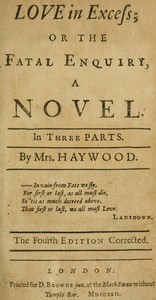
Love in Excess; or, the Fatal Enquiry A Novel in Three Parts — Background and Themes can be approached with a clearer sense of reading commitment from its source measurements: 97,129 words, 7 hr 3 min estimated reading time, and 15 detected text sections.
The text analysis averages about 54.2 words per sentence, while the detected sections provide another way to judge how the source is divided.
Project Gutenberg metadata also associates the work with “Love stories,” connecting these edition facts with the source record’s subject description.
Explore this collection
These alternatives are selected using recorded categories and estimated reading time.
About 434 minutes
Historical Psychological Social Fiction
99,633 recorded words. 11 minutes difference from this book's estimate.
View Gutenberg source #57560About 393 minutes
Historical Psychological Social Fiction
90,311 recorded words. 30 minutes difference from this book's estimate.
View Gutenberg source #62418About 454 minutes
Historical Psychological Social Fiction
104,419 recorded words. 31 minutes difference from this book's estimate.
View Gutenberg source #59437Search stored excerpts and compare books → Choose by your preferences →
Choices use stored catalog measurements. Estimates vary with reading speed. A shared category is a catalog label, not a claim that two books have the same argument or literary quality.
Search reads excerpt text stored with this catalog and links to its associated Gutenberg record. The connection is stored in the site database; this tool does not recheck that every excerpt is word-for-word identical to that external record. Excerpt search does not cover every chapter and does not verify historical publication dates.
Catalog snapshot checked: 2026-09-25. Coverage: 92 public books, 92 available source excerpts.
Read the complete public-domain text at its original source.
Read on Project GutenbergEliza Haywood's Love in Excess; or, the Fatal Enquiry (1722) opens with commendatory verses by Richard Savage and an anonymous admirer, praising the author's ability to "raise a Musick that can Love inspire." The novel itself, however, quickly moves beyond such flattery into a dense web of romantic entanglements and near-catastrophic misunderstandings. The catalog subjects—love stories, fathers and daughters, Bildungsromans, triangles, and aristocracy—are all present, but the excerpt shows a narrative more concerned with the mechanics of secrecy and the volatility of passion than with straightforward courtship or moral development.
The excerpt centers on a single night of high anxiety. Melliora, having overheard Alovisa and the Chevalier plotting to expose her as the Count's beloved, whispers to the Count: "for Heaven's Sake let me speak with you before Night." The Count mishears this as "at Night," a slip that propels the scene toward a dangerous assignation. Haywood emphasizes the gap between intention and perception: Melliora's plea for a daytime conversation becomes, in the Count's mind, an invitation for a nocturnal visit. This miscommunication is not merely a plot device but a structural principle in the novel, where characters repeatedly act on partial or distorted information. The narrator notes that the Count "misunderstood part of what she said," yet the consequences unfold with the force of inevitability. The scene demonstrates how a single misheard phrase can transform hope into dread, and how the characters' emotional states—jealousy, fear, desire—color their interpretations of events.
Haywood uses the physical setting of a closet—a small room or passage—as a crucial narrative device. Melliora, "indulging her Melancholly in that Closet," falls asleep and wakes to overhear Alovisa's scheme. The closet is not merely a hiding place but a threshold between public and private, where truths are accidentally revealed. The narrator describes it as "a sort of an Entry, or Passage, into another" room, emphasizing its liminal nature. Here, Melliora becomes an involuntary eavesdropper, learning of her own peril. The space amplifies the novel's themes of surveillance and vulnerability: characters are constantly observed or overheard, and secrets rarely remain contained. The closet scene also mirrors earlier moments in the novel where hidden listeners shape the action. Haywood's attention to architecture and spatial arrangement underscores how the built environment facilitates both intimacy and betrayal.
Haywood's narrator frequently steps back from the action to comment on the limits of language. When describing Melliora's distress, the narrator declares: "what Words can sufficiently express her Agonies? So I shall only say, they were too violent to have long kept Company with Life." This rhetorical gesture—acknowledging the inadequacy of words while still attempting to convey intensity—is a hallmark of the novel's style. The narrator also catalogues Melliora's emotions as "Guilt, Horrour, Fear, Remorse, and Shame at once oppress'd her," a list that suggests a psychological taxonomy of suffering. These intrusions do not distance the reader but rather heighten the sense of emotional overload. The novel's prose oscillates between rapid, breathless sentences and more measured, reflective passages, mirroring the characters' fluctuating states. Haywood's willingness to name extreme feelings—and to admit when they exceed representation—gives the narrative a raw, confessional quality that aligns with the era's emerging interest in interiority.
Readers approaching Love in Excess should attend to the gaps between what characters say, hear, and understand. The novel rewards careful attention to its spatial details—closets, chambers, passages—and to the narrator's asides about the limits of expression. Haywood's prose moves quickly, and the emotional stakes are high from the opening pages. The excerpt offers a concentrated example of how miscommunication and overheard secrets drive the plot, but the full novel likely extends these patterns across multiple characters and subplots. The catalog subjects provide a useful starting point, but the text itself is more interested in the volatility of passion than in moral lessons or social commentary.
I remember first meeting Melliora, that overheard plot thick with lovely misunderstandings, and it made me think of another quiet afternoon with The Missing Will—both stories keep their secrets close, guarded by words said a moment too soon or too late. There’s a tender ache in that, a kinship of hushed confusions. The Missing Will — Context and Discussion shares that same hush, a familiar weight.
Build a private reading journal entry for this title.









