About 325 minutes
Burgo's Romance — Key Ideas to Explore
Adventure Picaresque Fiction
74,652 recorded words. 16 minutes difference from this book's estimate.
View Gutenberg source #57944
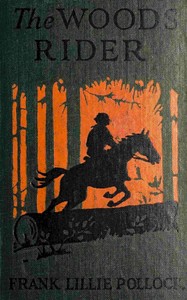
Before opening The Woods-Rider — Edition Insights, the edition data offers a quick orientation: 78,210 words, 5 hr 41 min estimated reading time, and 22 detected text sections.
The text analysis averages about 15.7 words per sentence, while the detected sections provide another way to judge how the source is divided.
Project Gutenberg metadata also associates the work with “Love stories,” connecting these edition facts with the source record’s subject description.
Explore this collection
These alternatives are selected using recorded categories and estimated reading time.
About 325 minutes
Adventure Picaresque Fiction
74,652 recorded words. 16 minutes difference from this book's estimate.
View Gutenberg source #57944About 323 minutes
Adventure Picaresque Fiction
74,229 recorded words. 18 minutes difference from this book's estimate.
View Gutenberg source #62304About 372 minutes
Adventure Picaresque Fiction
85,383 recorded words. 31 minutes difference from this book's estimate.
View Gutenberg source #59463Search stored excerpts and compare books → Choose by your preferences →
Choices use stored catalog measurements. Estimates vary with reading speed. A shared category is a catalog label, not a claim that two books have the same argument or literary quality.
Search reads excerpt text stored with this catalog and links to its associated Gutenberg record. The connection is stored in the site database; this tool does not recheck that every excerpt is word-for-word identical to that external record. Excerpt search does not cover every chapter and does not verify historical publication dates.
Catalog snapshot checked: 2026-09-25. Coverage: 92 public books, 92 available source excerpts.
Read the complete public-domain text at its original source.
Read on Project GutenbergFrank Lillie Pollock’s The Woods-Rider opens with a precise, almost documentary description of turpentine tapping: the long-leaf pine’s “livid scar, sticky with resinous exudation,” the tin gutters, and the cup “half full of the sticky whitish mass.” This attention to material detail—the “thin viscous threads” of gum, the “two-quart tin cup”—establishes a voice that is patient, observant, and grounded in the physical work of the woods. The narrative voice shifts between Joe Marshall’s internal reflections and a more detached, scenic narration, creating a rhythm that alternates between close-up labor and broader landscape views.
The narrator’s language is consistently concrete, favoring specific nouns and verbs over abstraction. In the opening chapter, Joe notes the trees “shooting up straight as arrows almost a hundred feet” and the ground “a tangle of gallberry-bushes.” This precision extends to the pacing: when Joe rides through the pine woods, the sentences are long and unhurried, mirroring the slow drip of gum. But when action arises—as in the later river scenes—the syntax tightens. The voice remains steady, but the rhythm accelerates, as when Bob and Carl wait “rather miserably in the darkness for more than an hour” before dawn breaks “low, swampy shores, looking monotonous and strange.” The shift from measured description to tense waiting is handled through sentence length and word choice, not through explicit commentary.
Pollock uses dialogue to modulate pace. In the excerpt from Chapter XI, Bob’s impatient exchange with Alice—“I can’t imagine why you didn’t count them, Bob!”—creates a quick, conversational rhythm that contrasts with the earlier, slower narrative of the turpentine orchard. The dialogue is functional, advancing the plot while revealing character. Yet the narrator often steps back, letting silence or action speak. When Bob and Carl wait on the river island, the description of “the low, swampy shores” and “the gray outlines of the cabin” carries the emotional weight without internal monologue. This alternation between talk and quiet observation gives the prose a varied tempo, keeping the reader attuned to both the characters’ urgency and the environment’s stillness.
The novel’s structure—chapter titles like “Wreck in the Woods,” “Buried Treasure,” “The Bee Raft”—suggests a series of episodes, each with its own pace. The opening chapter moves slowly, immersed in the sensory details of the pine forest. Later sections, such as the river journey in Chapter X, pick up speed with action verbs and shorter paragraphs: “The four barrels of rosin were transferred to the steamer.” The bee-related chapters introduce a new rhythm, combining the meticulous work of beekeeping with the tension of potential conflict. The narrator’s voice remains consistent—always precise, never florid—but the pacing adapts to the task at hand. This flexibility, rather than a uniform speed, characterizes the narrative’s movement through different landscapes and labors.
Throughout the excerpts, work is described in detail, but so is waiting. Joe “looked into the cup” and “glanced around at the other pines”; Bob and Carl “waited there rather miserably in the darkness for more than an hour.” These moments of pause are not filler; they build atmosphere and tension. The narrative voice treats both action and inaction with the same observational clarity, refusing to rush through downtime. This evenhandedness gives the prose a documentary quality, as if the narrator is as interested in the process of turpentining or bee-keeping as in the plot’s outcome. The result is a story that feels rooted in the real time of its setting, where gum drips slowly and boats arrive on schedule.
Readers attentive to narrative craft will find in The Woods-Rider a useful study in how pacing can be controlled through sentence structure, dialogue placement, and the balance of action and description. The novel rewards those who notice the shift from the languid opening to the quicker exchanges of the later chapters. Pay attention to how Pollock uses the physical environment—the pine forest, the river, the bayou—to set the tempo, and how the characters’ voices either accelerate or slow the narrative flow. The book’s episodic structure invites comparison of its different paces, making it a subtle but effective example of rhythm in popular fiction.
There’s a moment in The Woods-Rider when the narrative slows to the pace of bees working a gum-tree, and I thought of my own quiet notes in Creepin' Tintypes — Reading Notes. Both feel less like stories than like sittings, letting place press its unhurried print onto the page. A shared stillness, maybe.
Your answers remain private and are stored only in this browser.









